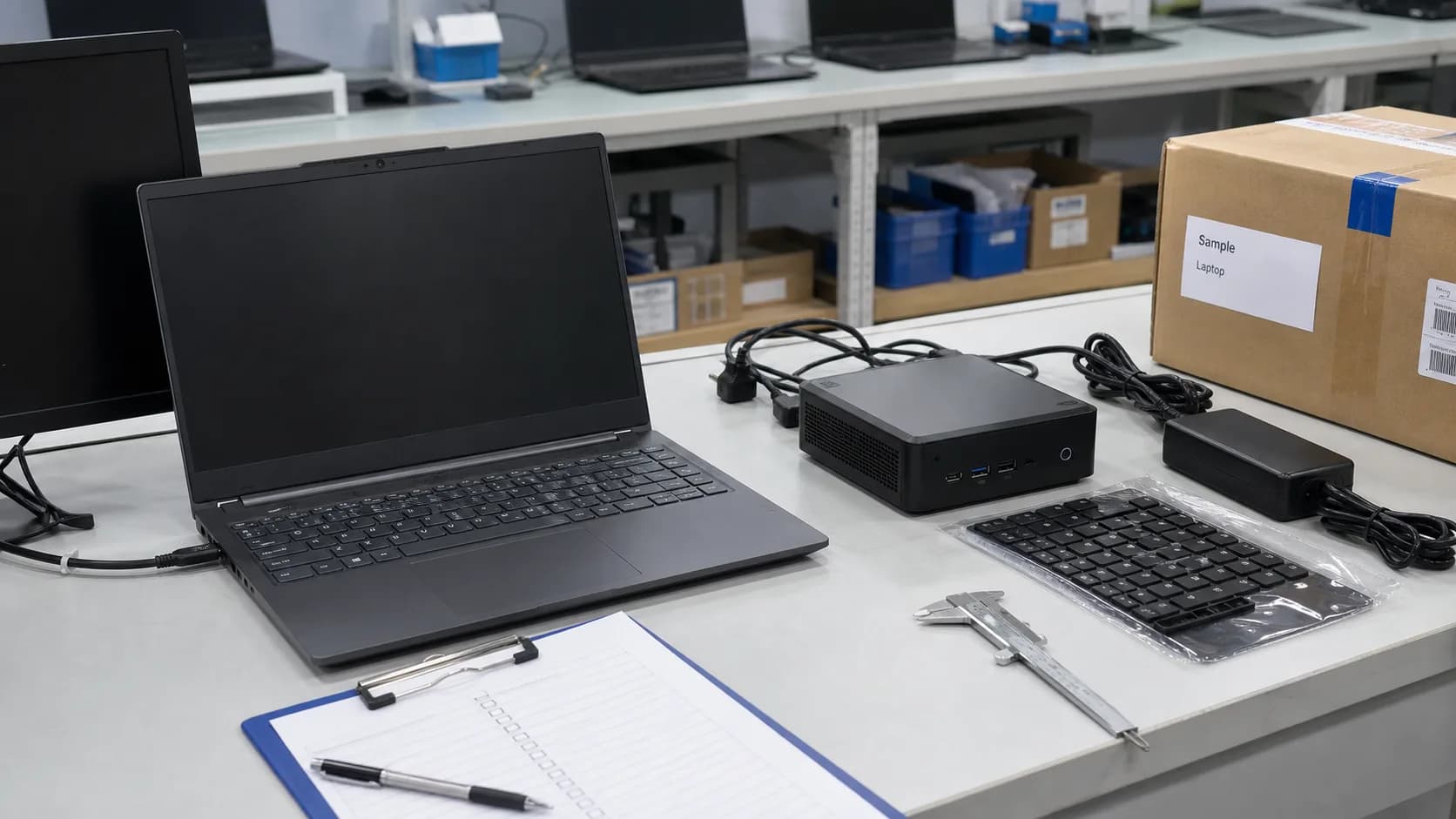
For end users, the choice is simple: buy a gaming laptop if they need a screen, keyboard, battery, and GPU in one portable machine; choose a gaming mini PC if the device will stay on a desk and the buyer already has a monitor, keyboard, and mouse.
For distributors, the decision is different. You are not only choosing what one gamer should buy. You are choosing which SKU family to import, test, localize, support, and hold in inventory.
The short answer:
- Stock gaming laptops first if your customers want one-box mobility, student gaming, retail shelf convenience, or a ready-to-use Windows device.
- Test gaming mini PCs first if your market already buys monitors and peripherals, wants compact desk setups, or values easier RAM/SSD configuration and lower shipping volume.
- For a mixed channel, start with one proven gaming laptop configuration and one proven gaming mini PC configuration before expanding the SKU list.
This guide explains how distributors, importers, and resellers should compare gaming laptops and gaming mini PCs before placing a bulk order with an OEM/ODM supplier.
Why Consumer Comparisons Do Not Answer Distributor Risk
Most ranking articles compare gaming laptops and mini PCs from the perspective of one buyer. They ask whether the buyer needs portability, whether a mini PC can handle games, whether it needs external peripherals, and whether it offers better value.
Those are useful questions, but they are not enough for a distributor.
A distributor also needs to ask:
- Which category is easier to sell through in the destination market?
- Which configuration can be tested and repeated safely?
- Which SKU creates fewer returns from heat, noise, power adapters, or driver issues?
- Which one is easier to localize with keyboard layout, plug type, packaging, language, and OS image?
- Which certification documents are available for the selected model and market?
- Who will handle local warranty and end-customer service?
That is why a B2B comparison should start with end-user demand, then move quickly into procurement risk.
The Basic Trade-Off: Mobility Versus Desk Performance
A gaming laptop is a self-contained gaming device. It includes the display, keyboard, trackpad, speakers, battery, wireless module, power adapter, and operating system image in one unit. This makes it easier to sell to students, mobile users, online buyers, and retail customers who want a complete device.
A gaming mini PC is a compact desktop-class box. It still needs an external monitor, keyboard, mouse, and wall power. Lenovo's mini PC glossary explains this difference clearly: a mini PC is stationary and requires external peripherals, while a laptop is portable and integrated. Intel's gaming laptop versus desktop guide makes a similar point: laptops win on portability, while desktop-style systems usually offer more room for ports, upgrades, and customization.
For distributors, this means:
- A gaming laptop is easier to sell as a complete product.
- A gaming mini PC is easier to position as part of a desk setup or bundled solution.
- A gaming laptop may carry more localization complexity because keyboard layout, battery behavior, charger, screen quality, and hinges all affect buyer satisfaction.
- A gaming mini PC may carry more setup complexity because the buyer needs compatible displays, cables, and peripherals.
Neither category is automatically better. The better first order depends on your sales channel.
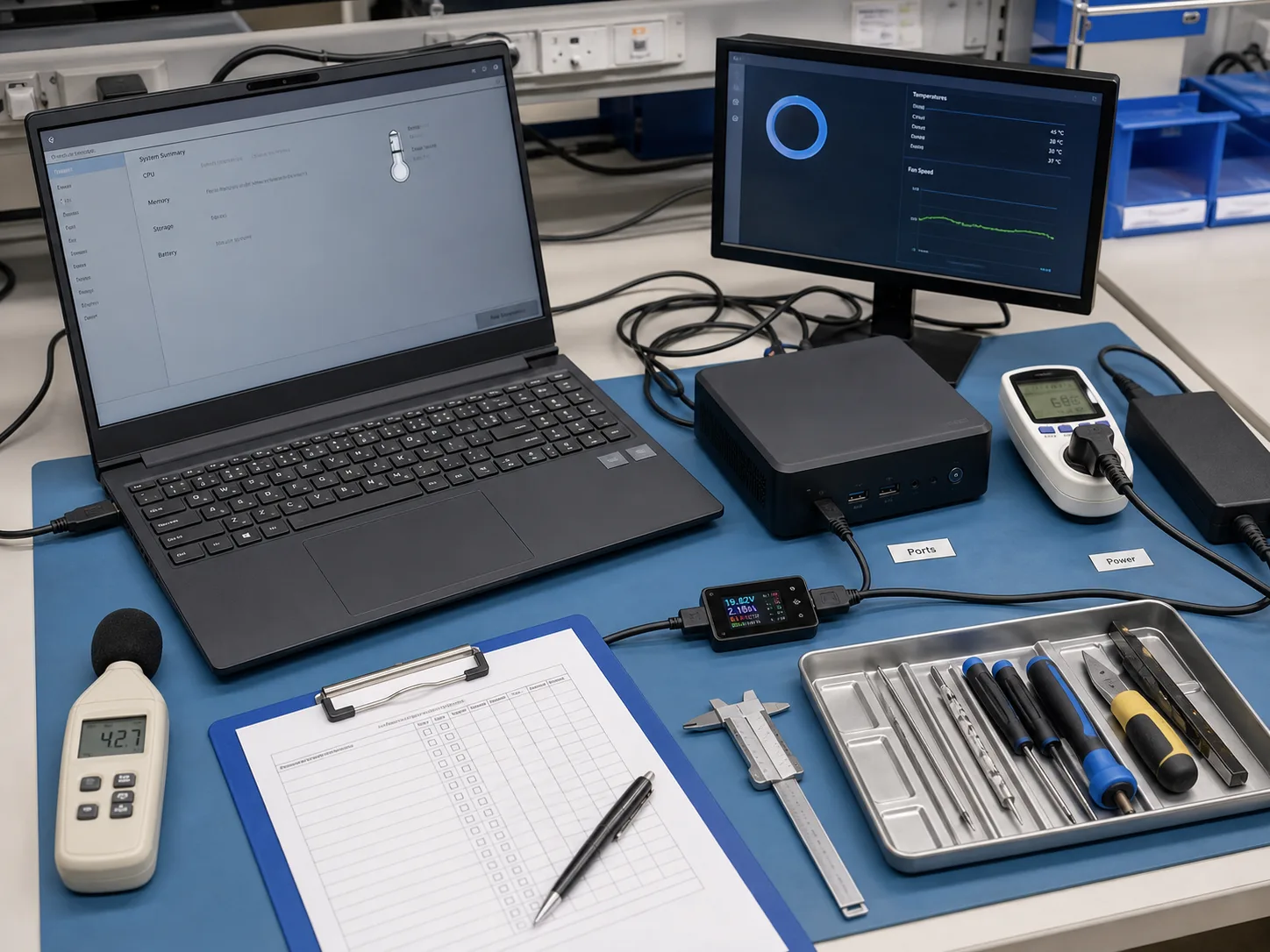
A distributor should compare the physical setup, ports, power behavior, thermals, and peripheral requirements before choosing the first SKU.
Distributor Stock Decision Matrix
| Decision point | Gaming laptop | Gaming mini PC | Distributor impact |
|---|---|---|---|
| End-user promise | Ready-to-use mobile gaming | Compact desk gaming | Laptops are easier for retail shelves; mini PCs fit bundled desk setups |
| Required accessories | Usually only mouse or headset | Monitor, keyboard, mouse, cable, wall power | Mini PC listings must explain what is included and what is not |
| Localization | Keyboard, OS language, charger, packaging | Plug, OS language, packaging, labels | Laptop keyboard layout can increase SKU complexity |
| Sample testing | Battery, display, thermals, keyboard, charger | Thermals, fan noise, ports, power adapter, display output | Both need real sample approval before bulk orders |
| Inventory risk | Higher unit value, more complete product | Lower footprint, but depends on buyer owning peripherals | Mini PCs may need clearer channel education |
| After-sales risk | Battery, screen, hinge, keyboard, thermal noise | Fan noise, ports, power adapter, driver/BIOS behavior | Warranty responsibility must be planned before order |
| Upgrade path | Often limited to RAM/SSD, model dependent | RAM/SSD may be easier, model dependent | Do not promise upgradeability until platform is confirmed |
| Shipping and storage | Larger carton and higher all-in-one value | Smaller carton, easier to store | Mini PCs may help first-order logistics if the market accepts them |
When To Stock Gaming Laptops First
Stock gaming laptops first when the sales channel needs a complete product that can be sold with minimal explanation.
This usually fits:
- Student gaming and back-to-school campaigns.
- Retail shops where buyers expect to open the box and start using the device.
- Online channels where product photos, screen size, keyboard, and GPU class drive clicks.
- Markets where buyers do not already own a gaming monitor or mechanical keyboard.
- Customers who move between dorms, offices, homes, or gaming events.
Before ordering, do not approve a laptop sample only from a spec sheet. Use the first sample review to confirm the buyer-visible items before the detailed approval table later in this guide:
- Exact platform, display, keyboard layout, charger, and OS image.
- Sustained performance on adapter power, including fan noise and surface temperature.
- Ports, wireless, webcam/audio, external display output, recovery, and activation.
- Label, carton, manual language, quote, and production BOM consistency.
Gaming laptops can be strong distributor products, but they leave less room for vague specifications. If the keyboard, panel, battery, or GPU power profile changes between sample and production, the buyer will notice.
If your channel specifically uses "gaming laptop" to mean a discrete-GPU notebook, confirm the current platform list, GPU class, cooling design, and sample benchmark before building product pages or taking pre-orders. Some projects may be better positioned as performance laptops, compact gaming mini PCs, or entry gaming bundles until the exact platform is locked.
When To Stock Gaming Mini PCs First
Stock gaming mini PCs first when the market wants compact performance for a fixed desk setup and the buyer already has peripherals.
This can fit:
- Esports rooms, cyber cafes, training rooms, and entertainment venues.
- Resellers selling monitor plus PC bundles.
- Apartment, hotel, or dorm setups where space matters.
- Office users who want one compact machine for work and light gaming.
- Markets where distributors can locally bundle monitors, keyboards, mice, and accessories.
The main selling point is not "portable gaming anywhere." A mini PC is not useful on a train or in a cafe without a monitor and power outlet. The selling point is compact desk performance, smaller packaging, cleaner installation, and easier configuration planning.
Use the mini PC sample stage to confirm:
- Sustained CPU/GPU behavior and fan noise after 30-60 minutes, not only at startup.
- HDMI, DisplayPort, USB-C display output, peripheral compatibility, and multi-monitor behavior.
- Power adapter wattage, plug type, label accuracy, and heat.
- RAM/SSD access, BIOS/driver stability, OS image repeatability, and packaging protection.
If your channel already sells displays and peripherals, gaming mini PCs can become a practical private-label category. If your channel sells only complete notebooks, the mini PC may require too much buyer education for the first bulk order.
OEM/ODM Customization Questions To Ask Early
Distributors often ask for custom branding after choosing the product category. That is too late. Customization can affect MOQ, sample timing, packaging, and document preparation.
For an OEM/ODM supplier, confirm these points before the quote is finalized:
- Logo printing, engraving, or badge options.
- Packaging design and carton labeling.
- Keyboard layout for gaming laptops.
- Regional power plug and adapter requirements.
- RAM and storage configuration.
- OS edition, language pack, driver image, and software pre-installation.
- BIOS logo or boot-screen branding, if supported by the selected platform.
- Accessory bundle: adapter, cable, mouse, manual, VESA mount, or other parts.
- Certification documents required by destination market.
The key phrase is "selected platform." Do not assume every customization is available on every laptop chassis or every mini PC motherboard. Confirm the actual sample platform first.
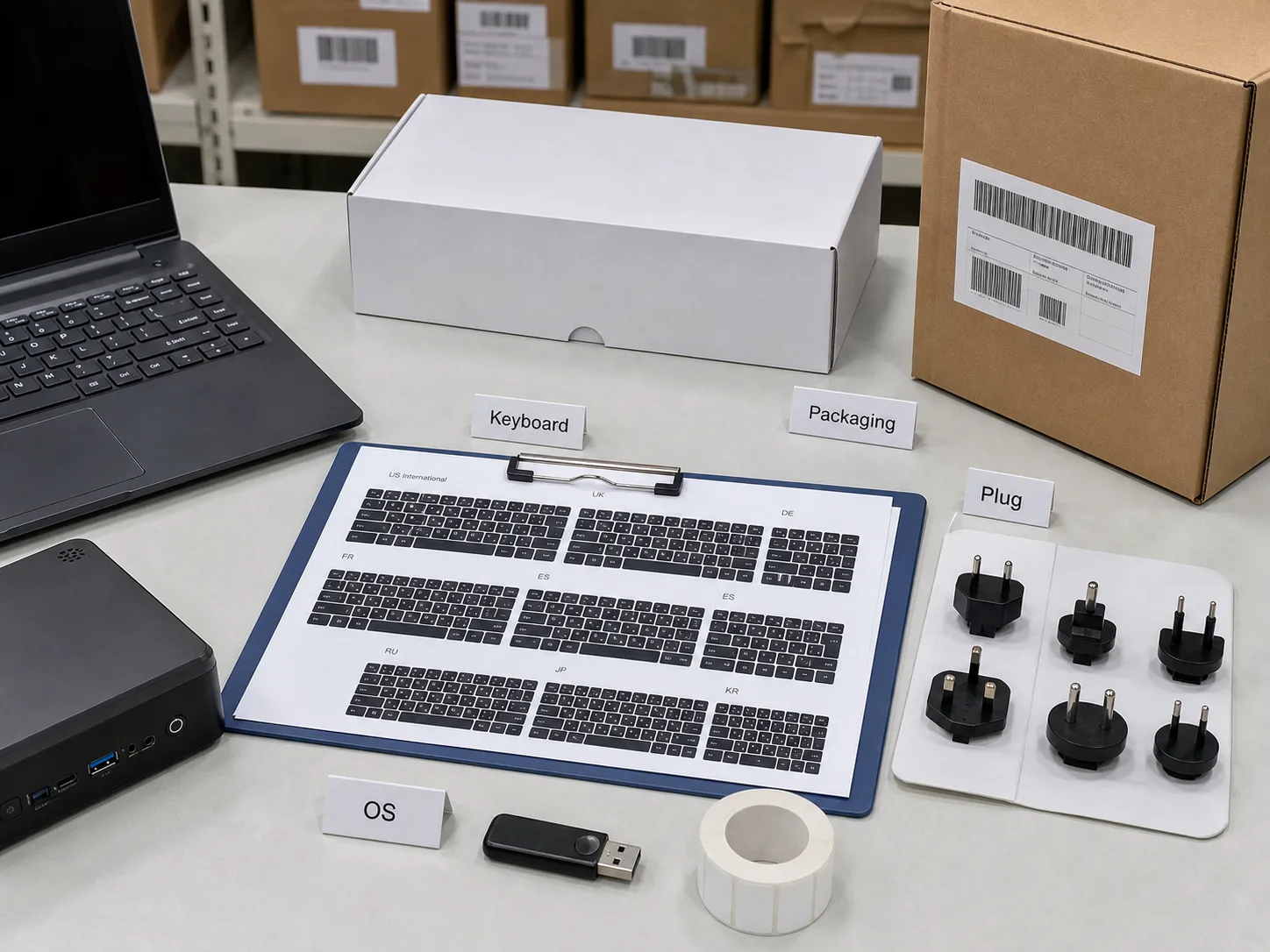
Keyboard layout, plug type, OS image, packaging, labels, and accessories can change SKU complexity before a distributor order is placed.
Sample Approval Before A 100+ Unit Order
For most AIERXUAN custom projects, MOQ starts from 100 units. Sample units can be discussed for testing and evaluation, normally in the 1-10 unit range. Sample lead time is typically 7-15 days. Standard production often takes 15-25 days after sample approval and final specification confirmation, while large orders may take 25-45 days depending on model, quantity, components, and customization.
Use the sample stage to remove ambiguity.
| Check item | Gaming laptop sample | Gaming mini PC sample |
|---|---|---|
| Hardware identity | CPU/GPU, RAM, SSD, wireless, panel, battery | CPU/GPU class, RAM, SSD, wireless, LAN, I/O ports |
| Thermal behavior | Keyboard/palm-rest heat, fan noise, adapter power gaming | Fan noise, chassis heat, sustained load, adapter heat |
| Localization | Keyboard layout, OS language, charger plug, manuals | Plug type, OS language, labels, manuals |
| Display behavior | Built-in screen and external display output | HDMI/DP/USB-C display output and monitor compatibility |
| Packaging | Retail box, carton protection, label accuracy | Carton protection, accessory layout, labels |
| Documents | Model-specific certificates and declarations | Model-specific certificates and declarations |
| Repeatability | Sample matches quotation and production BOM | Sample matches quotation and production BOM |
Only approve production after the buyer signs off the exact sample configuration.
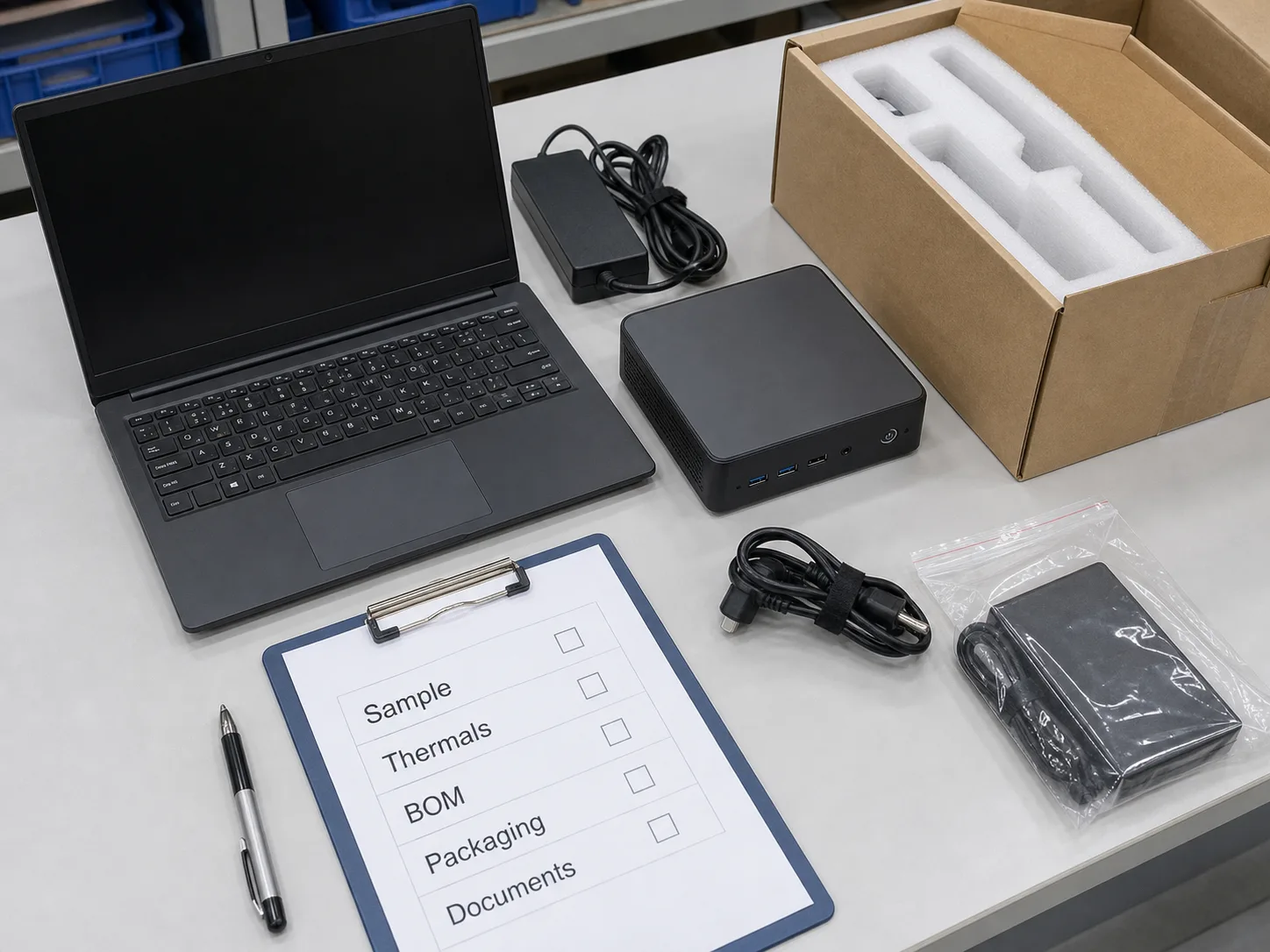
Sample approval should confirm the exact platform, thermal behavior, BOM, packaging, and document needs before production.
Certification, Logistics, And Warranty Split
Certification wording must stay precise. AIERXUAN can discuss CE, FCC, and RoHS product-level document needs, as well as ISO 9001 and ISO 14001 facility-level management system documentation. For a real order, certification documents should be confirmed by selected model, configuration, destination market, and document route.
Do not treat a certificate list as a universal promise for every SKU.
Distributors should also define:
- Who imports the goods.
- Who handles local customs clearance.
- Who translates user-facing materials.
- Who stores spare parts.
- Who handles end-customer returns.
- What warranty cases go back to the supplier and what cases are handled locally.
This is especially important for gaming devices because heat, fan noise, power adapters, display output, and driver behavior can create support tickets even when the hardware is technically working.
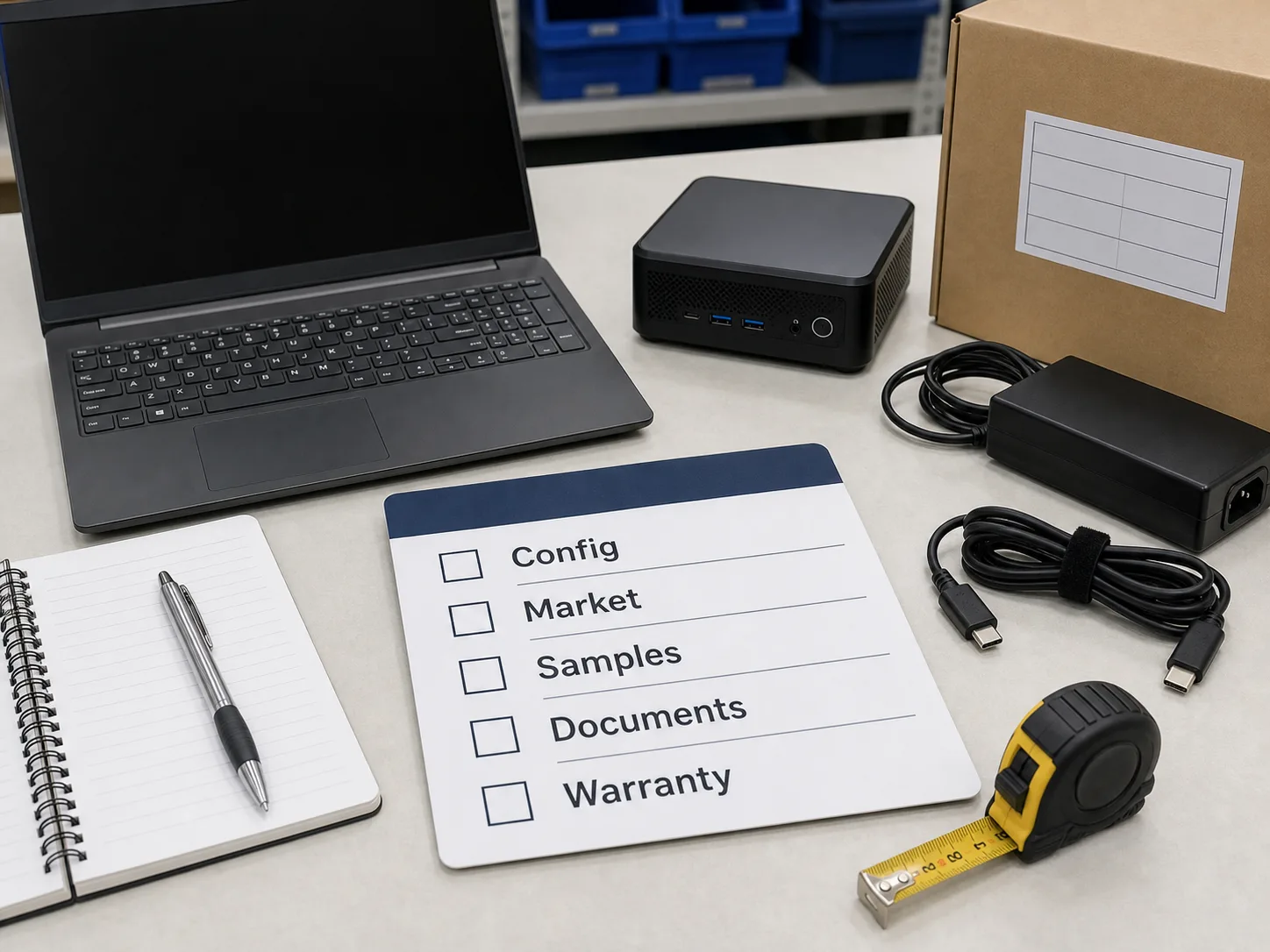
A structured RFQ helps suppliers quote the right platform and reduces mismatches between sample, BOM, documents, and warranty expectations.
RFQ Checklist For Gaming Laptop Or Gaming Mini PC Orders
Before asking for a quote, send a structured RFQ instead of a short message like "send gaming laptop price."
Include:
- Target category: gaming laptop, gaming mini PC, or both.
- Destination market and sales channel.
- Expected sample quantity and first bulk order quantity.
- Target CPU and GPU class, if already known.
- RAM and storage configuration.
- Display requirement for laptop models.
- Required ports and display output for mini PC models.
- Windows edition or Linux requirement.
- Keyboard layout and language needs.
- Power plug and adapter requirements.
- Logo, packaging, label, and manual requirements.
- Required certification documents.
- Target shipment window.
- Warranty and after-sales responsibility expectations.
- Whether the distributor wants one stable SKU or several price tiers.
The more specific the RFQ, the easier it is to quote the right platform and avoid production mismatch.
When To Offer Both Categories
Some distributors should not choose only one category. A stronger first portfolio may be:
- One gaming laptop SKU for mobile buyers.
- One gaming mini PC SKU for desk setups.
- One shared accessory bundle strategy: gaming mouse, keyboard, monitor, headset, or VESA mount where relevant.
- One sample approval checklist used across both categories.
This lets the distributor test actual market demand before building a wider product family.
The mistake is ordering too many variants too early. For a first 100+ unit custom order, it is usually safer to validate fewer SKUs with clearer positioning than to spread the order across many CPU/GPU/RAM/storage combinations.
How AIERXUAN Can Support Distributor Projects
AIERXUAN is an OEM/ODM laptop and Mini PC manufacturer in Shenzhen. Distributor projects can start by reviewing the broader product range, checking OEM/ODM customization services, and comparing Mini PC sourcing options through the Mini PC supplier page.
For gaming laptop or gaming mini PC sourcing, AIERXUAN can discuss:
- Product category and target configuration.
- Sample units for testing and evaluation.
- Hardware configuration by selected platform.
- Logo, packaging, keyboard, OS image, and BIOS/boot logo options when supported.
- Model-specific certification document needs.
- Production timing after sample approval.
Exact CPU/GPU availability, price, certification documents, and customization scope must be confirmed by selected model and order requirements.
To start a sourcing discussion, send your RFQ through the contact page with the target market, quantity, configuration, sample plan, localization needs, documents, and shipment timeline.
FAQ
Is a gaming mini PC better than a gaming laptop for distributors?
Not always. A gaming mini PC can be a better stock choice when the buyer already has a monitor and peripherals, or when the reseller can bundle a complete desk setup. A gaming laptop is usually better when the buyer wants a complete mobile device in one box.
What is the MOQ for custom gaming laptops or gaming mini PCs?
For most AIERXUAN custom projects, MOQ starts from 100 units. Sample units can be discussed for testing and evaluation before bulk production.
Should distributors test samples before bulk ordering?
Yes. Do not approve production only from a spec sheet. Test the exact sample for thermals, fan noise, power adapter, ports, OS image, packaging, and any localization items.
Can gaming laptops and gaming mini PCs be private-labeled?
OEM/ODM customization can be discussed, including logo, packaging, hardware configuration, software pre-installation, keyboard layout, and BIOS/boot-screen branding when supported by the selected platform. The exact scope must be confirmed by model.
Who handles local certifications and warranty?
Certification documents should be confirmed for the selected model, configuration, destination market, and document route. The distributor should also define local customs clearance, end-customer warranty, return handling, and spare-part responsibility before ordering.
What should a distributor include in an RFQ?
Include target category, quantity, destination market, CPU/GPU class, RAM, storage, OS, keyboard or plug requirements, branding, packaging, certification documents, sample timeline, production timeline, and after-sales responsibility expectations.

Bowen Yang
Sales Manager at AIERXUAN
Bowen works with overseas distributors, education buyers, and private-label hardware teams on laptop and Mini PC sourcing. He focuses on practical OEM/ODM requirements, sample confirmation, lead time, configuration options, and factory-direct communication.
View Author Profile →