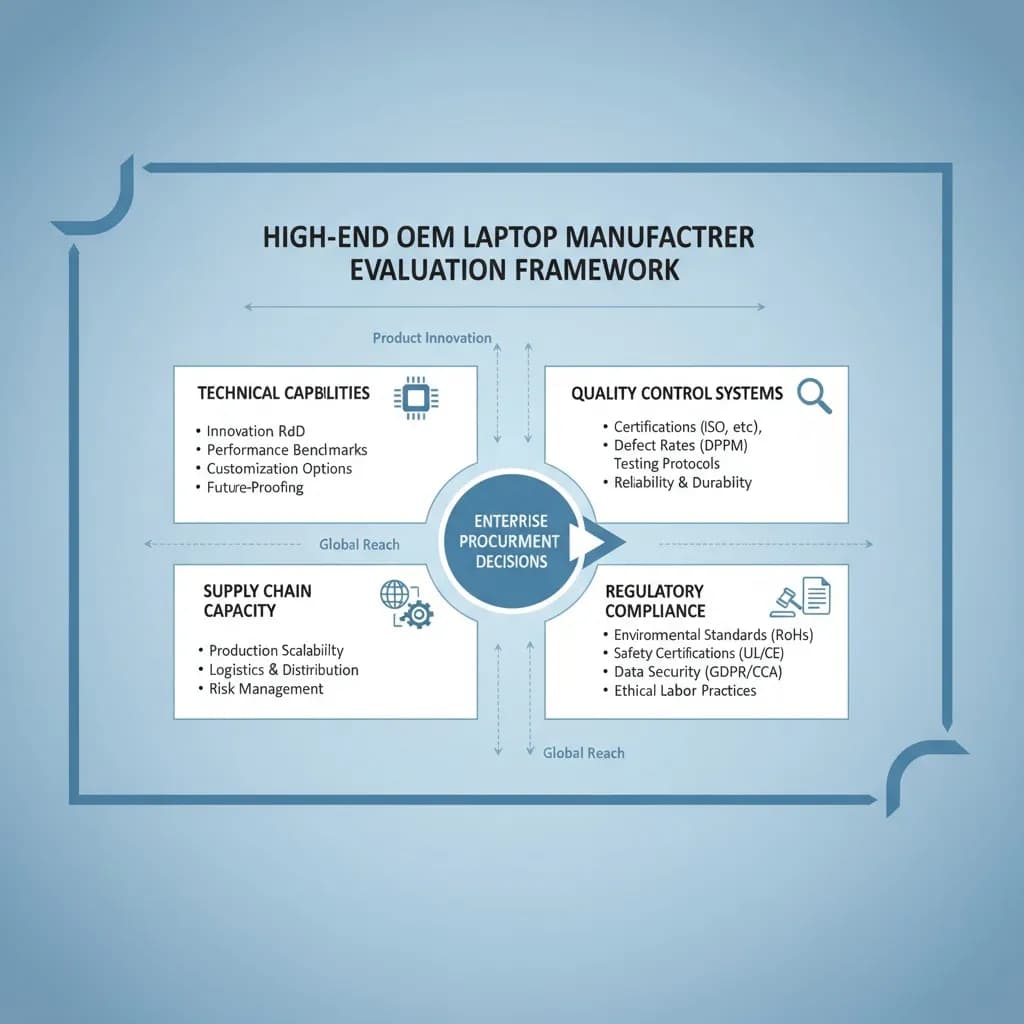
As an enterprise procurement manager, you're likely facing the critical challenge of sourcing high-end laptops from China's vast manufacturing landscape. The question isn't just about finding a supplier—it's about identifying a strategic partner who can deliver consistent quality, technical excellence, and supply chain reliability for your business needs.
China's high-end laptop OEM market represents a $59.36 billion industry, projected to reach $77.27 billion by 2032. This growth is driven by increasing demand for premium computing devices across global markets. However, with thousands of manufacturers claiming expertise, how do you separate the truly capable partners from the rest?
This comprehensive guide will walk you through the essential evaluation criteria, technical capabilities assessment, and quality control systems that define China's elite laptop manufacturers. Whether you're sourcing 1,000 or 100,000 units, the insights in this article will help you make informed decisions that protect your brand reputation and bottom line.

Table of Contents
- What Technical Capabilities Should You Evaluate in High-End OEM Manufacturers?
- How Can You Assess Quality Control Systems and Manufacturing Standards?
- What Supply Chain and Production Capacity Factors Matter Most?
- How Do You Verify Compliance and Certifications for Enterprise Requirements?
What Technical Capabilities Should You Evaluate in High-End OEM Manufacturers?
When I talk with procurement managers who've successfully partnered with Chinese manufacturers, the consistent message is that technical capabilities make or break the relationship. High-end laptop manufacturing isn't just about assembly—it's about sophisticated engineering, precision manufacturing, and innovative R&D that sets industry standards apart.
Let me break down the technical capabilities that separate premium manufacturers from standard assembly shops. First, Class 10,000 cleanroom facilities represent the bare minimum for high-end component handling. Leading manufacturers maintain 50-100 SMT (Surface Mount Technology) production lines with capabilities for ultra-fine pitch components (0402 metric and smaller). They've invested heavily in automated optical inspection (AOI) systems and X-ray detection capabilities for BGA (Ball Grid Array) component verification.
Precision engineering capabilities are particularly crucial for premium laptop chassis and thermal management systems. Look for CNC machining centers with 5-axis capabilities and tolerances as tight as ±0.02mm. Elite manufacturers typically invest in German and Japanese precision equipment—DMG Mori, Mazak, and Haas machines dominate this space. Metal unibody construction, increasingly standard in premium laptops, requires specialized equipment and expertise that only top-tier manufacturers possess.
The R&D infrastructure tells another crucial story. Leading OEMs maintain dedicated engineering teams of 200-500 professionals, including mechanical engineers, electrical engineers, and industrial designers. These teams typically hold advanced degrees from top technical universities and possess extensive experience with major international brands. When evaluating potential partners, ask about their patent portfolios—premium manufacturers typically file 20-50 patents annually and invest 8-12% of revenue in R&D.
Technical Capability Assessment Framework
| Capability Tier | Description | Key Indicators | Typical Applications |
|---|---|---|---|
| Premium Tier | Full-stack R&D and manufacturing | Class 10,000 cleanrooms, 100+ SMT lines, in-house testing labs | Enterprise laptops, gaming systems, ultrabooks |
| Mid-Tier | Strong manufacturing with limited R&D | Class 100,000 cleanrooms, 50-100 SMT lines, third-party testing | Business laptops, educational devices |
| Basic Tier | Assembly-focused operations | Clean assembly areas, <50 SMT lines, outsourced testing | Budget laptops, basic computing devices |
Essential Technical Questions to Ask
Before diving deeper into quality control systems, I want you to ask yourself these critical questions when evaluating manufacturers:
-
Can they demonstrate expertise in advanced display technologies? Mini-LED and OLED integration requires specialized knowledge that few manufacturers truly master.
-
What's their thermal management innovation track record? Premium laptops generate significant heat—look for proven solutions in heat pipe design, fan engineering, and chassis ventilation.
-
Do they have AI-accelerated hardware integration capabilities? This increasingly important feature requires specialized engineering expertise.
-
What's their approach to sustainable material engineering? Environmental compliance isn't just about certifications—it's about material innovation.
Quick Technical Capability Quiz
Test your understanding of premium manufacturer requirements:
Question 1: What's the minimum cleanroom class required for high-end laptop component assembly?
- A) Class 1,000
- B) Class 10,000
- C) Class 100,000
- D) No cleanroom needed
Question 2: How many SMT production lines should a premium manufacturer typically maintain?
- A) 10-25 lines
- B) 50-100 lines
- C) 100-200 lines
- D) 200+ lines
Question 3: What percentage of revenue should premium manufacturers invest in R&D?
- A) 2-5%
- B) 5-8%
- C) 8-12%
- D) 12-15%
Answers: 1-B, 2-B, 3-C

How Can You Assess Quality Control Systems and Manufacturing Standards?
Here's what separates the truly exceptional manufacturers from the merely competent ones: they don't just meet quality standards—they obsessively exceed them. Through my analysis of China's top OEM providers, I've found that quality control systems represent the single most important differentiator for enterprise procurement success.
The foundation begins with comprehensive quality management systems. ISO 9001:2015 certification represents the absolute minimum standard. Premium manufacturers should additionally maintain ISO 14001 (environmental management), ISO 45001 (occupational health and safety), and increasingly, IATF 16949 (automotive quality, surprisingly relevant for laptop components). TL 9000 certification indicates particular excellence in telecommunications and IT hardware manufacturing.
Process capability metrics provide objective evidence of manufacturing excellence. Look for Process Capability Index (Cpk) values above 1.33 for critical dimensions, indicating that the manufacturer can consistently produce parts within tight tolerances. First-pass yield rates should exceed 95% for complex assemblies, and statistical process control (SPC) implementation should be visible throughout production lines.
Testing infrastructure represents another critical evaluation point. Comprehensive testing capabilities should include EMI/EMC testing chambers, environmental stress screening (ESS) equipment, vibration and drop testing systems, battery safety testing laboratories, and thermal imaging analysis systems. I've found that manufacturers who invest heavily in testing infrastructure typically have lower defect rates and better customer satisfaction scores.
Quality Control Process Flow
-
Incoming Quality Control (IQC)
- 100% component verification
- Supplier qualification programs
- Material traceability systems
-
In-Process Quality Control (IPQC)
- Real-time monitoring
- Statistical process control
- First article inspection (FAI)
-
Final Quality Control (FQC)
- Comprehensive functional testing
- Aesthetic inspection
- Packaging verification
-
Quality Assurance (QA)
- Process audits
- Continuous improvement
- Customer feedback integration
Manufacturing Excellence Indicators
| Quality Metric | Premium Standard | Industry Average | Red Flag |
|---|---|---|---|
| Defect Rate (PPM) | <500 PPM | 1000-2000 PPM | >3000 PPM |
| First Pass Yield | >95% | 85-90% | <80% |
| On-Time Delivery | >98% | 90-95% | <85% |
| Customer Returns | <1% | 2-5% | >7% |
Advanced Quality Assessment Techniques
When evaluating potential manufacturing partners, I recommend requesting specific quality data beyond standard certifications. Ask for their internal process capability studies and failure mode effects analysis (FMEA) documentation. Premium manufacturers will have comprehensive data readily available and will be proud to share it.
Environmental testing capabilities are particularly important for high-end laptops destined for global markets. Look for testing that covers temperature extremes (-20°C to +60°C), humidity cycling, altitude testing, and drop testing from multiple angles. Manufacturers who can demonstrate thorough environmental validation typically produce more reliable products for demanding enterprise environments.
Quality System Verification Checklist
Before moving to supply chain considerations, use this assessment framework:
- ISO 9001:2015 certification current and verified
- Process capability indices (Cpk > 1.33) documented
- First-pass yield rates >95% consistently achieved
- Comprehensive testing laboratory on-site
- Statistical process control implemented
- Environmental stress testing capabilities demonstrated
- Failure analysis and corrective action procedures established
- Supplier quality management system in place
Quality Control Knowledge Assessment
Scenario Question: Your manufacturer reports a 99% quality rate but you notice increased customer returns. What investigation steps should you take?
A) Accept the reported quality rate and focus on customer service
B) Request detailed failure analysis data and return trends
C) Immediately switch to a new manufacturer
D) Implement additional incoming inspection at your facility
Correct Answer: B) Request detailed failure analysis data and return trends to understand the root cause of quality issues.

What Supply Chain and Production Capacity Factors Matter Most?
After years of working with enterprise procurement teams, I've learned that even the most technically capable manufacturers can fail if their supply chain and production capacity don't align with your business requirements. Let me walk you through the critical factors that determine whether a manufacturer can actually deliver on their promises.
Production capacity evaluation starts with understanding their annual output capabilities. For enterprise-scale partnerships, look for manufacturers with annual capacity of 5-10 million units and monthly production capability of 500,000-1,000,000 units. Minimum order quantities (MOQs) typically range from 10,000-50,000 units per configuration, with production lead times of 30-45 days for standard configurations.
Supply chain resilience has become increasingly critical in today's global environment. Leading manufacturers maintain multi-location production networks with primary facilities in Shenzhen, secondary locations in Guangdong Province, and increasingly, international production facilities in Vietnam, Mexico, or India. This geographic diversification protects your supply chain from regional disruptions.
Component sourcing strategies reveal much about a manufacturer's sophistication. Elite OEMs implement multi-sourcing strategies for critical components like processors, memory modules, and display panels. They maintain strategic inventory buffers of 60-90 days for key components and have established relationships with Intel, AMD, NVIDIA, and display panel manufacturers. Look for manufacturers who can demonstrate component qualification processes and supply chain visibility tools.
Production Capacity Requirements Matrix
| Business Scale | Required Annual Capacity | Typical MOQ | Lead Time | Risk Mitigation Strategy |
|---|---|---|---|---|
| Small Enterprise | 100K-500K units | 5K-10K units | 45-60 days | Single supplier with backup options |
| Medium Enterprise | 500K-2M units | 10K-25K units | 30-45 days | Primary + secondary suppliers |
| Large Enterprise | 2M-10M units | 25K-50K units | 20-30 days | Multi-location production network |
Supply Chain Risk Assessment Framework
Supply chain health indicators provide early warning signs of potential issues:
-
Financial Stability Metrics
- Debt-to-equity ratio below 0.6
- Minimum 3-6 months operating expense cash reserves
- Diverse customer base (no single customer >30% of revenue)
-
Operational Resilience Indicators
- Supplier diversity for critical components
- Inventory buffer management strategies
- Production flexibility and changeover capabilities
-
Quality and Compliance Infrastructure
- Comprehensive supplier qualification programs
- Incoming quality control systems
- Traceability systems for component-level tracking
Advanced Manufacturing Capabilities
Industry 4.0 implementation increasingly separates premium manufacturers from conventional assemblers. Look for IoT-enabled production equipment, real-time data analytics dashboards, predictive maintenance systems, and digital twin technology for process optimization. Manufacturers investing in these technologies typically demonstrate better quality consistency and production efficiency.
Lean manufacturing excellence represents another key differentiator. Evaluate their value stream mapping and optimization processes, waste reduction programs, cellular manufacturing approaches, and continuous improvement (Kaizen) programs. Manufacturers with mature lean practices typically achieve 20-30% higher productivity and significantly lower defect rates.
Supply Chain Partnership Evaluation
Before diving into compliance verification, consider these partnership evaluation criteria:
Technology Roadmap Alignment - Ensure your manufacturing partner's technology development aligns with your future requirements. Component technology advancement tracking and new product introduction planning should be coordinated.
Innovation Pipeline Management - Establish processes for ongoing innovation collaboration. Joint development opportunity identification and technology scouting capabilities can significantly enhance your competitive advantage.
Cost Optimization Framework - Look beyond unit price to total cost of ownership considerations. Design optimization for manufacturability and component cost reduction programs can deliver substantial long-term value.
Supply Chain Decision Assessment
Critical Decision Point: Your preferred manufacturer has excellent technical capabilities but relies on a single supplier for critical display panels. Their lead time is 30 days but they can't guarantee supply chain visibility. What's your best course of action?
A) Proceed with the partnership given their technical excellence
B) Require dual-sourcing before commitment
C) Implement buffer inventory at your own facilities
D) Look for alternative manufacturers with better supply chain diversification
Optimal Answer: B) Require dual-sourcing before commitment to ensure supply chain security while maintaining access to their technical capabilities.

How Do You Verify Compliance and Certifications for Enterprise Requirements?
This is where many procurement teams fall short—they focus on technical capabilities but neglect the regulatory and compliance frameworks that can make or break international distribution. Through my experience helping enterprises navigate Chinese manufacturing partnerships, I've learned that compliance verification is absolutely non-negotiable for enterprise-scale operations.
Regulatory compliance requirements vary significantly by target market. For distribution in the United States, FCC certification is mandatory, while European markets require CE marking. Canadian markets need IC certification, and Australian markets require RCM compliance. Chinese manufacturers targeting global markets must maintain CCC certification for domestic compliance, plus international standards.
Environmental compliance has become increasingly critical with RoHS and WEEE requirements governing hazardous substances and waste electrical equipment. Premium manufacturers demonstrate environmental leadership through sustainable material sourcing initiatives, carbon footprint reduction programs, and energy efficiency improvements in manufacturing processes. Look for manufacturers who go beyond basic compliance to embrace environmental stewardship as a core business principle.
Intellectual property protection represents another critical consideration, particularly for high-end laptop designs and proprietary technology. Assess their IP security measures including secure design transfer protocols, employee confidentiality agreements, physical security systems, and IT infrastructure security. Manufacturers with ISO 27001 certification demonstrate particularly strong information security management systems.
Global Compliance Requirements Matrix
| Target Market | Primary Certification | Additional Requirements | Typical Timeline | Verification Method |
|---|---|---|---|---|
| United States | FCC Part 15 | UL/ETL safety certification | 4-6 weeks | Test report verification |
| European Union | CE Marking | RoHS, WEEE compliance | 6-8 weeks | Technical file review |
| Canada | IC Certification | CSA safety standards | 4-6 weeks | Certificate validation |
| Australia | RCM Mark | AS/NZS safety standards | 6-8 weeks | Regulatory database check |
Advanced Certification Framework
Quality system certifications provide the foundation for compliance verification:
- ISO 9001:2015 - Quality management systems (minimum requirement)
- ISO 14001:2015 - Environmental management systems
- ISO 45001:2018 - Occupational health and safety
- IATF 16949:2016 - Automotive quality standards (relevant for premium components)
- TL 9000 - Telecommunications and IT hardware quality
Information security certifications increasingly important for protecting proprietary designs:
- ISO 27001:2022 - Information security management systems
- SOC 2 Type II - Security controls and operational effectiveness
- NIST 800-171 - Controlled unclassified information protection
Compliance Verification Best Practices
Documentation verification requires systematic approach. Request current certificate copies with valid expiration dates, scope limitations, and accredited certification body information. Verify certificate authenticity through the accreditation body's online database or direct contact.
Process audit verification provides additional assurance of compliance implementation. Ask for internal audit reports, management review meeting minutes, corrective action records, and continuous improvement program documentation. Manufacturers with robust compliance cultures will be transparent about their audit processes and results.
Supply chain compliance extends verification beyond the manufacturer to their critical suppliers. Component-level compliance verification, supplier audit programs, and material traceability systems provide assurance throughout the supply chain. Premium manufacturers maintain comprehensive supplier compliance programs that include regular audits and performance monitoring.
Enterprise Partnership Success Factors
Based on extensive analysis of successful manufacturing partnerships, I've identified the critical success factors that separate exceptional partnerships from disappointing ones:
Communication and collaboration frameworks include cultural alignment and understanding, governance structure establishment, and performance management systems. Language capabilities and business practice compatibility significantly impact partnership effectiveness.
Technology evolution and future-proofing ensures long-term partnership viability. Technology roadmap alignment, innovation pipeline management, and scalability assessment capabilities demonstrate forward-thinking partnership approaches.
Cost optimization and value creation frameworks extend beyond unit price considerations. Total cost of ownership analysis, value engineering opportunities, and long-term value creation mechanisms deliver sustainable competitive advantage.
Compliance Verification Assessment
Final Decision Scenario: You've identified a manufacturer with excellent technical capabilities and production capacity, but their compliance documentation appears outdated and they're reluctant to share detailed audit reports. What's your recommended course of action?
A) Proceed with a trial order while requesting updated documentation
B) Conduct independent third-party compliance verification
C) Require complete compliance documentation before any commitment
D) Look for alternative manufacturers with transparent compliance practices
Best Practice Answer: C) Require complete compliance documentation before any commitment. Compliance verification is non-negotiable for enterprise partnerships, and reluctance to share documentation raises significant red flags about the manufacturer's compliance maturity.

Recommended Tools and Resources for Manufacturer Evaluation
To support your manufacturer evaluation process, I've compiled these essential tools and resources that leading procurement teams rely on:
Assessment Tools:
- Manufacturer capability audit templates
- Quality system evaluation checklists
- Supply chain risk assessment frameworks
- Compliance verification databases
Industry Resources:
- China Electronics Chamber of Commerce certification database
- Global Semiconductor Alliance supplier directories
- Display manufacturer association membership lists
- International trade compliance resources
Professional Networks:
- Enterprise Procurement Association communities
- China manufacturing working groups
- Technology supply chain forums
- Quality management professional organizations
Conclusion: Building Strategic Manufacturing Partnerships in China
Finding the right high-end OEM laptop manufacturer in China requires systematic evaluation across technical capabilities, quality systems, supply chain resilience, and regulatory compliance. The manufacturers that excel in premium laptop production combine world-class technical infrastructure with sophisticated engineering expertise and proven partnership success.
For enterprise procurement managers, the decision extends beyond manufacturing capacity to encompass strategic alignment, innovation capabilities, and long-term partnership potential. China's elite manufacturers offer more than production services—they provide comprehensive technology partnerships that can accelerate product development, improve quality performance, and drive competitive advantage.
The manufacturers that distinguish themselves in premium laptop manufacturing share common characteristics: substantial R&D investment (8-12% of revenue), advanced testing capabilities, diverse customer portfolios, and proven success with major international brands. They typically maintain 200-500 engineering team members, hold extensive patent portfolios (20-50 annually), and demonstrate consistent quality performance with defect rates below 500 PPM.
By following the systematic evaluation framework outlined in this guide, procurement managers can identify manufacturing partners capable of delivering not just high-quality laptops, but strategic value that extends across product lifecycles and technology generations. The right partnership transforms manufacturing from a cost center into a competitive advantage that drives business success.
China's manufacturing ecosystem continues evolving, with leading manufacturers increasingly focusing on Industry 4.0 implementation, sustainability initiatives, and advanced technology integration. Partners who align with these trends position themselves for long-term success in the dynamic premium laptop market.
The question becomes not whether to partner with Chinese manufacturers, but how to select and structure partnerships that maximize mutual value while mitigating risks and ensuring sustained competitive advantage in the global marketplace.
External Resources and Further Reading
- China Electronics Chamber of Commerce - Industry certification and compliance resources
- Global Semiconductor Alliance - Supply chain intelligence and manufacturer directories
- International Trade Administration - China manufacturing regulations and compliance requirements
- Quality Management Institute - Quality system certification and audit resources
- Manufacturing Leadership Council - Industry best practices and partnership frameworks
Frequently Asked Questions
What actually separates a high-end OEM from a generic Chinese laptop factory?
Three things: (1) genuine R&D capability — own mechanical/EE engineers who can modify boards, not just rebadge reference designs; (2) Tier-1 component supply contracts (Intel China Channel, Samsung/SK Hynix DRAM, Sharp/AUO panels) that survive tight allocation cycles; (3) automated SMT lines + AOI/X-ray inspection rather than manual rework. Ask to see the line, not just the brochure.
How long is a realistic sample-to-mass-production timeline for a customized SKU?
Plan 6–10 weeks for first engineering sample (EVT), 4–6 weeks for DVT/PVT cycles, 8–12 weeks for first mass production batch after PVT sign-off. Total: 4–7 months from spec freeze to FOB. Anyone quoting "2 months total" is either rebadging an existing model or skipping qualification stages.
Which certifications should I verify in person, not just on the spec sheet?
CE/FCC/RoHS are the baseline. For enterprise deployment also verify ISO 9001 (quality system) and ISO 14001 (environmental) at the factory level — not the trading company level. Request the latest audit report with its issuance date; many certificates are valid on paper but the last surveillance audit is 2+ years old.
Can a high-end Chinese OEM handle low MOQ for premium configurations?
Yes for shared platforms (~300–500 units MOQ on a stock chassis with customized BIOS/branding). No for ground-up custom mechanicals (typically 3,000–5,000+ MOQ to amortize tooling). The smarter path for sub-1,000 unit orders is to start with an existing chassis and customize firmware, keyboard, and packaging.
How does AIERXUAN fit the high-end OEM profile?
AIERXUAN runs a 15,000㎡ facility with 50,000+ monthly capacity, ISO 9001/14001 certified, Intel China Channel Partner since 2019, and 500,000+ units shipped across 50+ countries. We support both shared-platform low-MOQ customization and full-custom mechanical projects. Send your high-end OEM brief.
Related Reading

Bowen Yang
Sales Manager at AIERXUAN
Bowen works with overseas distributors, education buyers, and private-label hardware teams on laptop and Mini PC sourcing. He focuses on practical OEM/ODM requirements, sample confirmation, lead time, configuration options, and factory-direct communication.
View Author Profile →