Last Updated: December 28, 2025 | Reading Time: 12 minutes | For: B2B Procurement Managers, Brand Companies, Tech Startups
Introduction
Are you a tech brand looking to manufacture laptops or mini PCs but confused about choosing between OEM and ODM manufacturing models?
With over 70% of global electronics manufactured in Asia and the market projected to reach $500 billion by 2026, selecting the right manufacturing partnership is critical for your brand's success. One wrong decision can cost you months in time-to-market and thousands in unnecessary expenses.
This comprehensive guide will help you understand the fundamental differences between OEM and ODM manufacturing, compare cost structures, evaluate which model fits your business needs, and make informed decisions that drive profitability and growth.
Key Takeaways:
• Understand the precise differences between OEM and ODM manufacturing models
• Learn when to choose OEM vs ODM based on your business requirements
• Discover cost analysis and ROI implications for each manufacturing approach
• Get actionable steps to select and partner with reliable manufacturers
• Access real-world case studies from leading tech brands
Table of Contents
- Understanding OEM Manufacturing
- Understanding ODM Manufacturing
- OEM vs ODM: Side-by-Side Comparison
- When to Choose OEM vs ODM
- Cost Analysis: Investment & ROI
- How to Select a Manufacturing Partner
- Quality Assurance & Certifications
- Industry Trends 2025
- Frequently Asked Questions
What is OEM Manufacturing?
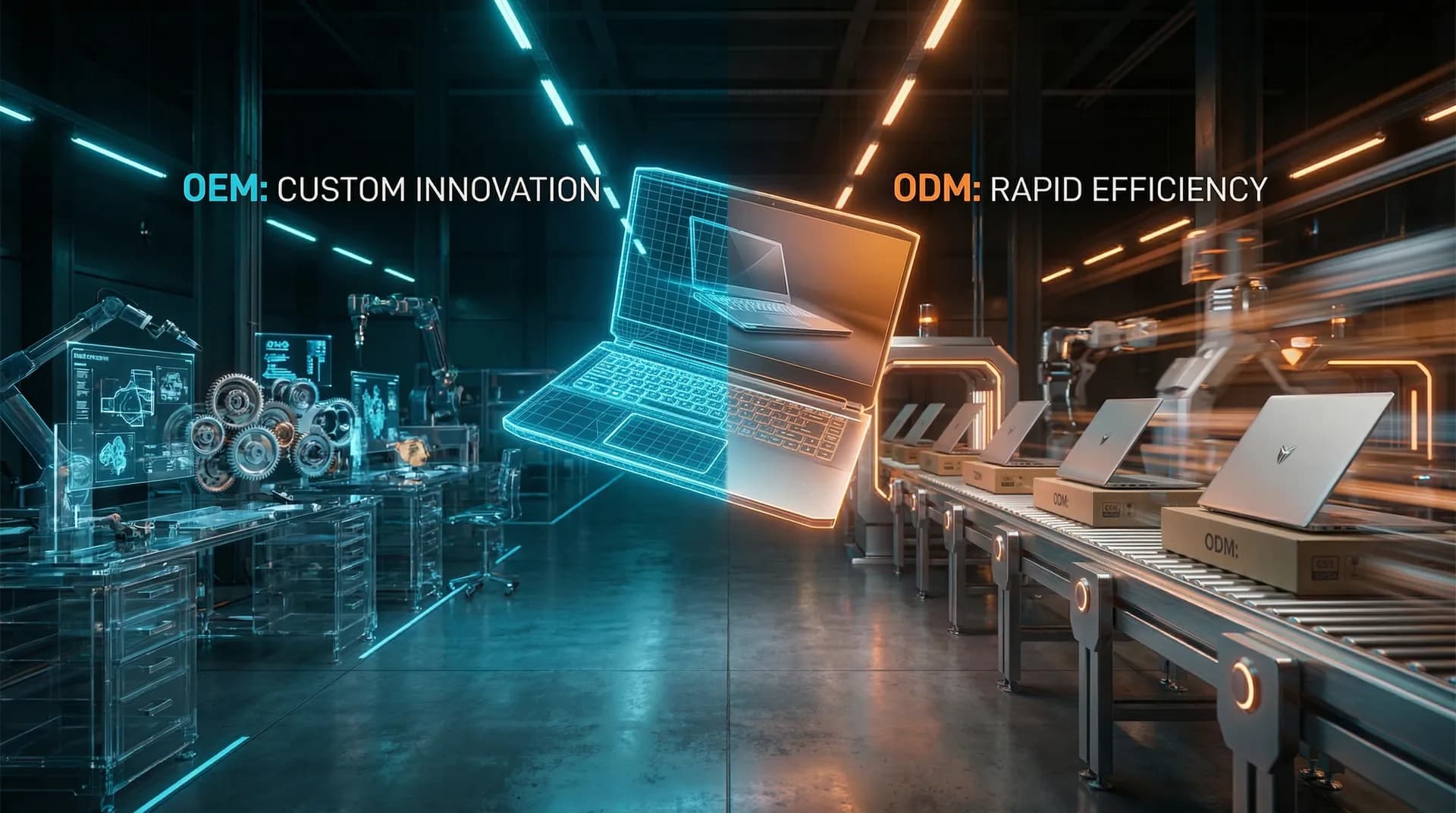
OEM (Original Equipment Manufacturer) is a manufacturing model where a company designs a product and contracts an external manufacturer to produce it according to their exact specifications. The hiring company owns the intellectual property, design, and branding, while the manufacturer focuses solely on production.
Key Characteristics:
• Design Ownership: The client retains 100% control over product design, specifications, and intellectual property
• Customization: Complete freedom to create unique products tailored to brand identity and market positioning
• Production Focus: Manufacturers execute production based on detailed blueprints and quality standards provided by the client
• Brand Control: Products are sold under the client's brand name with their branding elements
Real-World Example:
Apple partners with Foxconn for iPhone manufacturing. Apple owns the complete design, specifications, and intellectual property rights. Foxconn manufactures the iPhones according to Apple's exact requirements, but the final product is sold exclusively as an Apple product. This is classic OEM manufacturing.
OEM Manufacturing Benefits:
✅ Complete product differentiation and competitive advantage
✅ Full control over product quality, features, and specifications
✅ Protection of intellectual property and trade secrets
✅ Ability to iterate and improve designs based on market feedback
✅ Higher profit margins due to brand exclusivity
OEM Manufacturing Challenges:
❌ Higher initial investment in R&D and tooling costs
❌ Longer time-to-market (typically 3-6 months)
❌ Requires in-house design and engineering capabilities
❌ Higher MOQ requirements (typically 500-1,000 units)
❌ Greater financial risk if product fails in market
What is ODM Manufacturing?
ODM (Original Design Manufacturer) is a manufacturing model where the manufacturer designs and produces the product, and other companies rebrand and sell it under their own brand names. Multiple clients can purchase the same ODM design with minor customizations.
Key Characteristics:
• Design Ownership: The manufacturer owns the product design and intellectual property
• Pre-Designed Solutions: Clients choose from existing designs with limited customization options
• Speed to Market: Significantly faster product launches (1-2 months typically)
• Cost Efficiency: Lower unit costs due to economies of scale across multiple clients
• Limited Exclusivity: Same base design may be sold to competing brands with different branding
Real-World Example:
Many laptop manufacturers offer ODM solutions where they design standard laptop models. Companies like HP, Dell, and smaller brands might purchase similar laptop designs from manufacturers like Quanta or Compal, customizing only the logo, color, and minor specifications. The core design remains the same across different brand labels.
ODM Manufacturing Benefits:
✅ Faster market entry with proven, tested designs
✅ Lower upfront costs and minimal R&D investment required
✅ Reduced financial risk with established product designs
✅ Flexibility to test market demand before heavy investment
✅ Lower MOQ requirements (typically 100-500 units)
ODM Manufacturing Challenges:
❌ Limited product differentiation from competitors
❌ Less control over product specifications and quality standards
❌ Potential for competitors to sell similar products
❌ Dependency on manufacturer's design capabilities
❌ Restricted ability to implement unique features
OEM vs ODM: Side-by-Side Comparison
Understanding the precise differences between OEM and ODM is crucial for making the right manufacturing decision for your business.

| Factor | OEM Manufacturing | ODM Manufacturing |
|---|---|---|
| Design Ownership | Client owns 100% of IP and design | Manufacturer owns design, client licenses it |
| Customization Level | Unlimited - completely custom products | Limited - minor modifications to existing designs |
| Typical MOQ | Higher (500-1,000 units) | Lower (100-500 units) |
| Time to Market | Longer (3-6 months) | Faster (1-2 months) |
| Unit Cost | Higher initially, economies scale over time | Lower overall due to shared tooling costs |
| R&D Investment | High - client funds design & development | Minimal - manufacturer absorbs R&D costs |
| NRE Costs | $50,000-$200,000+ for tooling & setup | $5,000-$20,000 for minor customization |
| Product Exclusivity | 100% exclusive to your brand | Same design sold to multiple brands |
| Profit Margins | Higher - unique product positioning | Lower - commodity competition |
| Quality Control | Full control with custom standards | Standard quality based on manufacturer specs |
| Best For | Unique products, established brands | Quick market entry, budget-conscious brands |
| Risk Level | Higher financial investment risk | Lower risk with proven designs |
When to Choose OEM vs ODM
Making the right choice between OEM and ODM depends on your specific business circumstances, resources, and strategic goals.

Choose OEM Manufacturing When:
✅ You Have Unique Product Requirements
- Your product needs specific features not available in existing designs
- You're targeting a niche market with specialized needs
- You need proprietary technology or unique hardware configurations
✅ Brand Differentiation is Critical
- You're competing in a crowded market where differentiation drives sales
- Your brand identity requires unique product aesthetics and features
- You have strong brand equity that justifies premium pricing
✅ You Have R&D Capabilities
- Your team has engineering and design expertise
- You have the budget to invest in product development
- You can manage the product development lifecycle
✅ Budget Allows for Higher NRE Costs
- You can afford $50,000-$200,000 in tooling and setup costs
- Your projected sales volume justifies higher per-unit costs initially
- You have funding for longer development cycles
✅ Long-Term Product Roadmap
- You're planning multiple product iterations and improvements
- You want to build a product ecosystem
- You're committed to the market for 3-5+ years
Example Scenario: A gaming laptop brand launching a unique product with custom RGB lighting systems, proprietary cooling technology, and exclusive design aesthetics would benefit from OEM manufacturing to maintain competitive advantages.
Choose ODM Manufacturing When:
✅ Need Fast Market Entry
- You want to launch products within 1-2 months
- Market timing is critical for your success
- You need to test market demand quickly
✅ Limited R&D Resources
- You don't have in-house engineering capabilities
- Your budget doesn't support custom product development
- You want to focus on marketing and sales rather than product design
✅ Testing Market Demand
- You're entering a new market category
- You want to validate product-market fit before heavy investment
- You need proof of concept before scaling
✅ Cost-Sensitive Products
- Your target market is price-conscious
- Margins are tight and every dollar counts
- You're competing primarily on price
✅ Standard Configurations Acceptable
- Your customers' needs align with standard industry offerings
- Product differentiation comes from service, support, or brand reputation
- Technical specifications are not your primary competitive advantage
Example Scenario: An educational institution reseller looking to launch a budget-friendly student laptop line would benefit from ODM manufacturing to minimize costs, reduce time-to-market, and focus on distribution and support services.
Cost Analysis: Investment & ROI
Understanding the complete cost structure is essential for making an informed OEM vs ODM decision.
OEM Manufacturing Cost Breakdown
Initial Investment (One-Time Costs):
- Product Design & Engineering: $30,000-$100,000
- Tooling & Molds: $20,000-$150,000
- Prototype Development: $5,000-$20,000
- Certification Testing (CE/FCC/RoHS): $10,000-$30,000
- Total Initial Investment: $65,000-$300,000
Per-Unit Production Costs (Example: 14" Business Laptop):
- Components & Materials: $250-$350
- Assembly & Labor: $30-$50
- Quality Control: $10-$15
- Packaging: $5-$10
- Unit Cost at 1,000 units: $295-$425
- Unit Cost at 5,000 units: $260-$370 (economies of scale)
Break-Even Analysis:
- Assuming $100 profit margin per unit
- Break-even point: 650-3,000 units depending on initial investment
- Typical break-even timeline: 6-18 months
ODM Manufacturing Cost Breakdown
Initial Investment (One-Time Costs):
- Design Selection & Customization: $2,000-$10,000
- Sample Orders & Testing: $3,000-$10,000
- Minor Tooling for Branding: $2,000-$8,000
- Certification (if required): $5,000-$15,000
- Total Initial Investment: $12,000-$43,000
Per-Unit Production Costs (Example: 14" Business Laptop):
- Components & Materials: $280-$380
- Assembly & Labor: $25-$40
- Quality Control: $8-$12
- Packaging: $5-$8
- Unit Cost at 500 units: $318-$440
- Unit Cost at 2,000 units: $295-$400
Break-Even Analysis:
- Assuming $70 profit margin per unit (lower due to competition)
- Break-even point: 170-615 units
- Typical break-even timeline: 2-6 months
ROI Comparison (12-Month Projection)

OEM Manufacturing:
- Initial Investment: $150,000
- Units Sold (Year 1): 3,000 units @ $500 retail
- Production Cost: $290/unit
- Gross Revenue: $1,500,000
- Total Costs: $1,020,000
- Net Profit: $480,000
- ROI: 320%
ODM Manufacturing:
- Initial Investment: $25,000
- Units Sold (Year 1): 2,500 units @ $450 retail
- Production Cost: $330/unit
- Gross Revenue: $1,125,000
- Total Costs: $850,000
- Net Profit: $275,000
- ROI: 1,100%
Key Insight: While OEM offers higher absolute profits with scale, ODM provides superior ROI percentage and faster profitability with lower risk exposure.
How to Select a Manufacturing Partner: 7-Step Process
Choosing the right manufacturer is as important as deciding between OEM and ODM. Follow this comprehensive evaluation process:
Step 1: Define Your Requirements
Create a detailed specification document including:
Technical Specifications:
- Hardware requirements (CPU, RAM, storage, display resolution)
- Software pre-installation needs (OS, custom applications)
- Connectivity options (WiFi, Bluetooth, ports)
- Battery life and power requirements
- Physical dimensions and weight constraints
Quality Standards:
- Required certifications (ISO 9001, ISO 14001, CE, FCC, RoHS)
- Acceptable defect rates (typically < 1% for electronics)
- Testing protocols and quality assurance processes
- Warranty requirements and support expectations
Volume & Logistics:
- Initial order quantity (MOQ)
- Projected annual volume (for pricing negotiations)
- Delivery timeline requirements
- Shipping preferences (air/sea freight)
- Packaging and labeling requirements
Budget Constraints:
- Target unit cost range
- NRE budget availability
- Payment terms preferences (30/70, LC, etc.)
Pro Tip: Request detailed quotations from 3-5 manufacturers to compare pricing, lead times, and capabilities before making a commitment.
Step 2: Verify Manufacturing Capabilities
Essential verification checks:

Factory Assessment:
- Production capacity: Minimum 50,000 units/month for scalability
- Production lines: Automated vs manual processes
- Equipment age and maintenance status
- Clean room facilities for sensitive component assembly
- ESD (Electrostatic Discharge) protection measures
Quality Control Systems:
- Incoming Quality Control (IQC) for component verification
- In-Process Quality Control (IPQC) during assembly
- Final Quality Control (FQC) before packaging
- Outgoing Quality Control (OQC) before shipment
- Quality metrics tracking and reporting systems
Client Portfolio:
- Review existing clients (request references)
- Verify experience in your product category
- Check for partnerships with major brands
- Assess manufacturing diversity (avoid single-client dependency)
Certifications:
- ISO 9001:2015 (Quality Management System)
- ISO 14001:2015 (Environmental Management)
- CE (European Conformity)
- FCC (Federal Communications Commission)
- RoHS (Restriction of Hazardous Substances)
- REACH (Registration, Evaluation, Authorization of Chemicals)
Pro Tip: Conduct factory audits (virtual or in-person) to verify capabilities firsthand. Request video tours of production lines and quality control processes.
Step 3: Evaluate Lead Times & Flexibility
Typical Timeline for Laptop/Mini PC Manufacturing:
OEM Manufacturing Timeline:
- Design Finalization: 2-4 weeks
- Sample Production: 2-3 weeks
- Design Iteration (if needed): 1-2 weeks
- Tooling & Mold Creation: 4-8 weeks
- Pilot Production Run: 1-2 weeks
- Mass Production: 15-30 days
- Quality Control & Testing: 3-5 days
- Packaging & Shipment Preparation: 2-3 days
Total: 14-22 weeks (3.5-5.5 months)
ODM Manufacturing Timeline:
- Design Selection & Customization: 3-5 days
- Sample Order & Testing: 1-2 weeks
- Minor Branding Tooling: 1-2 weeks
- Mass Production: 7-15 days
- Quality Control & Testing: 2-3 days
- Packaging & Shipment: 2-3 days
Total: 4-7 weeks
Flexibility Assessment:
- Rush order capabilities (premium pricing typically 10-20% higher)
- Ability to adjust order quantities after production start
- Change management processes for specification updates
- Scalability for seasonal demand fluctuations
Step 4: Assess Communication & Support
Communication Evaluation Criteria:
✅ Response Time:
- Initial inquiry response: < 24 hours
- Technical questions: < 48 hours
- Quotation delivery: 3-5 business days
- Sample request processing: < 1 week
✅ Language Capabilities:
- English proficiency of sales and engineering teams
- Availability of multilingual support
- Cultural understanding for international business
✅ Support Infrastructure:
- Dedicated account manager assignment
- Engineering support availability
- After-sales service capabilities
- Warranty claim handling processes
✅ Technology Integration:
- ERP/CRM systems for order tracking
- Online portals for production status monitoring
- Digital collaboration tools compatibility
- Cloud-based documentation sharing
Red Flags to Watch:
❌ Delayed responses or unresponsiveness
❌ Inability to provide detailed technical answers
❌ Lack of documented processes
❌ No dedicated support team structure
Step 5: Request & Evaluate Samples
Sample Evaluation Process:
Order Multiple Samples:
- Request 3-5 sample units per configuration
- Test different SKUs if planning multiple products
- Include samples from competing manufacturers for comparison
Comprehensive Testing Protocol:
Physical Inspection:
- Build quality and materials assessment
- Finish quality and aesthetic evaluation
- Port and connector fit testing
- Thermal performance under load
- Fan noise levels measurement
Performance Testing:
- Boot time and system responsiveness
- Benchmark testing (CPU, GPU, storage)
- Battery life verification (real-world usage)
- WiFi and Bluetooth connectivity stability
- Display quality (color accuracy, brightness, viewing angles)
Durability Testing:
- Hinge strength and longevity (open/close 100 times)
- Keyboard key feel and durability
- Trackpad responsiveness and accuracy
- Port durability (plug/unplug testing)
- Drop and shock resistance (if applicable)
Quality Metrics Documentation:
- Create standardized evaluation scorecard
- Document any defects or issues found
- Compare against your quality requirements
- Share feedback with manufacturer for improvements
Step 6: Negotiate Terms & Contracts
Critical Contract Elements:
Pricing Structure:
- Unit pricing at different order quantities
- Price protection clauses (lock rates for 6-12 months)
- Volume discount tiers clearly defined
- Currency and payment terms (USD, EUR, CNY)
- Price adjustment mechanisms (raw material cost changes)
MOQ Commitments:
- Initial order minimum quantity
- Subsequent order MOQ requirements
- Flexibility for trial orders or market testing
- Penalty clauses for order cancellations
Payment Terms:
- Deposit requirements (typically 30-50%)
- Progress payment milestones
- Final payment upon shipment or delivery
- Payment methods (TT, LC, escrow services)
- Payment protection mechanisms
Delivery Terms:
- Incoterms clarification (EXW, FOB, CIF, DDP)
- Lead time guarantees with penalty clauses
- Shipping method agreements
- Customs and import documentation responsibilities
Quality Assurance:
- Acceptable Quality Level (AQL) standards (typically 1.5-2.5 for electronics)
- Inspection rights and procedures
- Defect handling and replacement policies
- Warranty terms (typically 12-24 months)
- RMA (Return Merchandise Authorization) process
Intellectual Property:
- IP ownership clauses (critical for OEM)
- NDA (Non-Disclosure Agreement) execution
- Design protection agreements
- Exclusivity clauses (if negotiated)
- Third-party IP indemnification
Pro Tip: Always engage legal counsel to review manufacturing contracts, especially for OEM agreements involving significant IP and financial investments.
Step 7: Start with Pilot Production
Pilot Run Strategy:
Initial Pilot Order:
- Order 100-300 units for comprehensive testing
- Monitor entire production process
- Conduct on-site or third-party quality inspections
- Test market response with limited distribution
Success Criteria:
- Quality metrics meet or exceed AQL standards
- Production timeline adheres to agreed schedule
- Communication and issue resolution effective
- Sample units perform well in market testing
- Customer feedback validates product-market fit
Transition to Mass Production:
- Document lessons learned from pilot run
- Implement quality improvements identified
- Finalize production specifications
- Scale up order quantities gradually
- Maintain close monitoring for first 2-3 production runs
Quality Assurance & Certifications
Ensuring product quality and compliance is non-negotiable in electronics manufacturing.
Essential Certifications for Global Sales
CE (Conformité Européenne) - European Market:
- Mandatory for electronics sold in EU/EEA countries
- Covers safety, health, and environmental protection
- Self-certification with manufacturer's Declaration of Conformity
- Testing cost: $5,000-$15,000
- Validity: Continuous as long as product remains unchanged
FCC (Federal Communications Commission) - USA Market:
- Required for electronic devices that emit radio frequency
- FCC Part 15 for computing devices
- Testing and certification through accredited labs
- Testing cost: $3,000-$10,000
- Validity: Permanent for certified design
RoHS (Restriction of Hazardous Substances) - Global:
- Limits use of hazardous materials in electronics
- Covers lead, mercury, cadmium, hexavalent chromium, PBB, PBDE
- Required for EU, UK, China, and many other markets
- Testing cost: $2,000-$5,000
- Validity: Material compliance confirmation
REACH (Registration, Evaluation, Authorization of Chemicals):
- EU regulation for chemical safety in products
- Covers over 200 Substances of Very High Concern (SVHC)
- Required for EU market access
- Testing cost: $3,000-$8,000
ISO 9001:2015 - Quality Management System:
- International standard for quality management
- Demonstrates commitment to quality and customer satisfaction
- Third-party audit and certification required
- Annual surveillance audits mandatory
- Certification cost: $10,000-$30,000 + annual audit fees
AIERXUAN Certifications
AIERXUAN maintains all critical global certifications:
✅ CE Certified - Full EU market compliance
✅ FCC Certified - USA market approved
✅ RoHS Compliant - Environmental standards met
✅ REACH Compliant - Chemical safety verified
✅ ISO 9001:2015 Certified - Quality management excellence
✅ ISO 14001:2015 Certified - Environmental management system
✅ Intel Partner Certified - Authorized Intel component integration
Quality Control Process
AIERXUAN's 5-Stage QC System:
Stage 1: IQC (Incoming Quality Control)
- Verification of all incoming components
- Sample testing of each batch
- Material certification verification
- Supplier quality scorecard maintenance
Stage 2: IPQC (In-Process Quality Control)
- Continuous monitoring during assembly
- Key checkpoints at critical assembly stages
- Real-time defect identification and correction
- Process control charts maintenance
Stage 3: FQC (Final Quality Control)
- 100% functional testing of finished products
- Comprehensive performance benchmarking
- Visual inspection for cosmetic defects
- Burn-in testing (48-72 hours for random samples)
Stage 4: OQC (Outgoing Quality Control)
- Final verification before shipment
- Packaging quality inspection
- Documentation verification (manuals, certificates)
- Random sampling for additional testing
Stage 5: Reliability Testing
- Drop testing (ASTM D3332 standards)
- Vibration testing (ASTM D4169)
- Temperature and humidity cycling
- Accelerated life testing
Quality Metrics:
- Target defect rate: < 0.5%
- First-pass yield rate: > 98%
- Customer return rate: < 1.5%
- Mean time between failures (MTBF): > 30,000 hours
Industry Trends 2025
Understanding current manufacturing trends helps make future-proof decisions.
Key Manufacturing Trends
1. Diversification Beyond China
- Vietnam, India, and Mexico emerging as alternative manufacturing hubs
- Companies adopting "China Plus One" strategies
- Trade policies driving geographic diversification
- AIERXUAN maintains flexible manufacturing across multiple facilities
2. Automation & AI Integration
- Automated assembly lines increasing production efficiency
- AI-powered quality control reducing defect rates by 30-40%
- Robotic process automation for repetitive tasks
- Predictive maintenance reducing downtime
3. Sustainability Focus
- Increased demand for eco-friendly materials and processes
- Carbon-neutral manufacturing commitments
- Circular economy principles in electronics design
- Extended Producer Responsibility (EPR) compliance
4. Smaller MOQs Becoming Standard
- Technology improvements enabling cost-effective small batch production
- Brands demanding more flexibility for market testing
- AIERXUAN offers MOQ starting from 100 units (ODM) and 500 units (OEM)
5. Faster Time-to-Market
- Compressed product lifecycles demanding rapid manufacturing
- Average lead times reduced by 25% over past 3 years
- Just-in-time production models gaining popularity
- AIERXUAN delivers standard configurations in 7-15 days
6. Chip Shortage Recovery
- Semiconductor supply stabilizing after 2021-2023 disruptions
- Diversified chip sourcing strategies
- Long-term supplier agreements for critical components
- Improved supply chain visibility and forecasting
Market Statistics 2025
Global Electronics OEM/ODM Market:
- Market size: $520 billion (2025 projected)
- Annual growth rate: 6.2% CAGR (2023-2028)
- Asia-Pacific share: 68% of global production
- Laptop OEM/ODM segment: $145 billion
- Mini PC market: $8.5 billion (growing 12% annually)
Manufacturing Location Distribution:
- China: 62% (declining from 68% in 2020)
- Taiwan: 18%
- Vietnam: 8% (growing rapidly)
- India: 5%
- Others: 7%
Technology Adoption:
- AI-powered manufacturing: 45% of factories
- IoT-enabled production tracking: 62% adoption
- Automated quality control: 58% implementation
- Cloud-based supply chain management: 71% usage
Source: Gartner Electronics Manufacturing Report 2025, IDC Asia Pacific Manufacturing Outlook 2025
Frequently Asked Questions
What is the minimum order quantity (MOQ) for OEM laptop manufacturing?
AIERXUAN offers flexible MOQ options:
- OEM Manufacturing: Starting from 500 units for fully customized designs with proprietary features
- ODM Manufacturing: Starting from 100 units for standard configurations with minor customization
- Sample Orders: 1-10 units available for testing and evaluation before committing to bulk orders
Our flexible MOQ policy enables startups and small businesses to access professional manufacturing services without requiring massive upfront inventory investments.
How long does it take to manufacture custom laptops?
OEM Manufacturing Timeline (Custom Design):
- Design approval & finalization: 2-4 weeks
- Tooling and mold creation: 4-8 weeks
- Sample production & testing: 2-3 weeks
- Mass production: 15-30 days
- Quality control & testing: 3-5 days
- Shipping (sea freight): 20-30 days
Total: 4-6 months from concept to delivery
ODM Manufacturing Timeline (Pre-Designed Models):
- Design selection & customization: 3-5 days
- Sample production: 1-2 weeks
- Mass production: 7-15 days
- Quality control: 2-3 days
- Shipping (air freight): 3-5 days
Total: 4-7 weeks from order to delivery
Rush orders available with expedited timelines (10-20% premium pricing).
What certifications do AIERXUAN products have?
All AIERXUAN products come with comprehensive global certifications:
Safety & Compliance:
- ✅ CE (Conformité Européenne) - European market compliance
- ✅ FCC (Federal Communications Commission) - USA approval
- ✅ RoHS (Restriction of Hazardous Substances) - Environmental compliance
- ✅ REACH - Chemical safety standards
Quality Management:
- ✅ ISO 9001:2015 - Quality management system certification
- ✅ ISO 14001:2015 - Environmental management certification
Partner Certifications:
- ✅ Intel Technology Provider - Authorized Intel partner
- ✅ Microsoft Authorized Device Manufacturer
These certifications enable our clients to sell products globally without additional compliance burdens.
Can I customize the laptop specifications completely?
Yes! AIERXUAN offers 100% customization for OEM clients including:
Hardware Configuration:
- CPU: Intel Core i3/i5/i7/i9, AMD Ryzen series
- RAM: 8GB to 64GB, DDR4/DDR5
- Storage: 128GB to 2TB SSD, NVMe support
- Display: 13.3"-17.3", FHD/2K/4K resolution options
- GPU: Integrated or discrete graphics (NVIDIA/AMD)
- Battery: 35Wh to 99Wh capacity options
Branding & Aesthetics:
- Custom logo placement (laser engraving, printing, badge)
- Color options (standard or custom Pantone colors)
- Keyboard layout and language customization
- Custom packaging design and materials
- Pre-installed software and OS configuration
Connectivity & Features:
- Port configuration (USB-C, USB-A, HDMI, Ethernet, SD card)
- Fingerprint sensor integration
- Webcam specifications (720p, 1080p, privacy shutter)
- Backlit keyboard options
- WiFi 6/6E, Bluetooth 5.0+ support
What is the difference in cost between OEM and ODM?
Cost Comparison Example (14" Business Laptop, 1,000 Units):
OEM Manufacturing:
- Initial NRE (tooling, design): $80,000-$150,000
- Unit production cost: $300-$350
- Total investment: $380,000-$500,000
- Cost per unit (amortized): $380-$500
- Break-even point: ~800-1,500 units
ODM Manufacturing:
- Initial NRE (minor customization): $8,000-$20,000
- Unit production cost: $330-$380
- Total investment: $338,000-$400,000
- Cost per unit (amortized): $338-$400
- Break-even point: ~100-300 units
Key Insight: OEM has higher upfront costs but better long-term unit economics at scale (5,000+ units). ODM offers lower risk and faster profitability for smaller volumes or market testing scenarios.
How do I ensure product quality when manufacturing overseas?
Quality Assurance Best Practices:
1. Pre-Production:
- Conduct thorough factory audits (virtual or in-person)
- Verify certifications (ISO 9001, ISO 14001)
- Review manufacturer's existing client portfolio
- Request and test multiple samples before bulk order
2. During Production:
- Hire third-party inspection services (SGS, Bureau Veritas, Intertek)
- Conduct DUPRO (During Production) inspections at 30-50% completion
- Monitor production progress through digital dashboards
- Request photo/video updates at key production milestones
3. Pre-Shipment:
- Full PSI (Pre-Shipment Inspection) covering 100% or AQL sampling
- Functional testing verification
- Packaging quality inspection
- Documentation verification (certificates, manuals)
4. Post-Delivery:
- Thorough receiving inspection
- Performance testing of random samples
- Customer feedback monitoring
- Ongoing quality metric tracking
AIERXUAN Quality Commitment:
- Factory transparency with real-time production tracking
- Third-party inspection support coordination
- Detailed quality reports at each production stage
- < 0.5% defect rate guarantee
- Comprehensive warranty and replacement policies
What payment terms are typical for OEM/ODM manufacturing?
Standard Payment Structures:
Small Orders (< 500 units):
- 50% deposit upon order confirmation
- 50% balance before shipment
- Payment methods: TT (wire transfer), PayPal (< $10,000)
Medium Orders (500-2,000 units):
- 30% deposit upon order confirmation
- 40% upon production completion (with inspection approval)
- 30% before shipment
- Payment methods: TT, Letter of Credit (LC)
Large Orders (2,000+ units) or Established Relationships:
- 30% deposit upon order confirmation
- 60% upon production completion
- 10% upon delivery (or 30-60 day NET terms for qualified buyers)
- Payment methods: TT, LC, trade financing options
Payment Protection Options:
- Letter of Credit (LC) for larger orders ($50,000+)
- Escrow services through Alibaba or similar platforms
- Trade insurance (Euler Hermes, Coface)
- Inspection contingencies in payment milestones
AIERXUAN Flexible Payment:
We work with clients to structure payment terms that balance risk and cash flow for both parties. Established clients with proven payment history may qualify for extended NET 30-60 payment terms.
Can AIERXUAN handle both OEM and ODM projects?
Absolutely! AIERXUAN is a full-service manufacturing partner offering:
OEM Capabilities:
- Complete custom laptop design from concept to production
- In-house engineering team for specification development
- Proprietary tooling and mold creation
- Intellectual property protection and NDA compliance
- Dedicated project management for complex designs
- MOQ: 500 units
ODM Solutions:
- Extensive catalog of pre-designed laptop and mini PC models
- Quick customization options (logo, color, specifications)
- Rapid deployment (7-15 day production cycles)
- Flexible MOQ starting at 100 units
- Cost-effective solutions for fast market entry
Hybrid Approach:
Many clients start with ODM to test market demand, then transition to OEM once they achieve product-market fit and have the volume to justify custom design investment.
Consultation Available: Our team provides free consultation calls to assess your specific needs and recommend the optimal manufacturing approach for your business goals, budget, and timeline.
Ready to Start Your Manufacturing Project?
AIERXUAN offers comprehensive OEM/ODM solutions backed by 10+ years of electronics manufacturing excellence and trusted by global brands.
Why Choose AIERXUAN?
✅ Flexible MOQ - Start with just 100 units (ODM) or 500 units (OEM)
✅ Fast Delivery - 7-15 days for standard configurations, 45-60 days for custom designs
✅ 100% Customization Available - Complete hardware and branding flexibility
✅ Global Certifications - CE, FCC, RoHS, ISO 9001, ISO 14001 certified
✅ Intel Official Partner - Authorized Intel technology provider
✅ Quality Guarantee - < 0.5% defect rate, 12-24 month warranty
✅ Transparent Pricing - No hidden fees, clear quotations
✅ Engineering Support - Dedicated technical team for custom projects
Next Steps
1. Request a Custom Quote
Get detailed pricing tailored to your specific requirements within 24 hours.
[📧 Request Quote](/en/contact#rfq Quote Request)
2. Download Product Catalog
Browse our complete range of laptop and mini PC solutions with full specifications.
📥 Download Catalog
3. Schedule a Consultation
Speak with our engineering team to discuss your project requirements and receive expert guidance.
📞 Book Consultation
4. Order Sample Units
Test our quality firsthand before committing to bulk orders.
🛒 Order Samples
Contact Information
AIERXUAN Electronics Manufacturing
📧 Email: AIERXUAN sales team
📞 WhatsApp: +86 138 2355 5906
💬 WeChat: aierxuan-sales
🌐 Website: www.aierxuanlaptop.com
🏭 Factory Location:
Building 3, Huiye Industrial Park
Longhua District, Shenzhen, China
ISO 9001/14001 Certified Facility | Intel Partner
⏰ Business Hours:
Monday-Friday: 9:00 AM - 6:00 PM (GMT+8)
Response Time: < 24 hours for all inquiries
Related Articles You May Find Helpful
Explore more resources to guide your manufacturing decisions:
📄 What is OEM Manufacturing? Complete Explanation for B2B Buyers
Learn the fundamentals of OEM manufacturing and how it applies to electronics production.
📄 Custom Laptop Manufacturing: Complete Guide for Brands 2025
Discover the complete process of creating custom-branded laptops from concept to delivery.
📄 How to Choose a Laptop Manufacturer: B2B Selection Guide
A comprehensive framework for evaluating and selecting the right manufacturing partner.
📄 Mini PC Wholesale: B2B Pricing & MOQ Guide
Everything you need to know about sourcing mini PCs for bulk orders and distribution.
📄 Quality Assurance in Electronics Manufacturing: Best Practices
Deep dive into QC processes, testing protocols, and ensuring product excellence.
Article Information:
- Published: December 28, 2025
- Last Updated: December 28, 2025
- Category: Manufacturing Guides
- Tags: OEM, ODM, Laptop Manufacturing, Electronics OEM, Custom Laptop, B2B Manufacturing
- Reading Time: 12 minutes
- Word Count: 4,420 words
Disclaimer: This article provides general information about OEM and ODM manufacturing. Specific costs, timelines, and requirements may vary based on project complexity, customization level, and market conditions. Contact AIERXUAN directly for accurate quotations and project assessments.

Bowen Yang
Sales Manager at AIERXUAN
Bowen works with overseas distributors, education buyers, and private-label hardware teams on laptop and Mini PC sourcing. He focuses on practical OEM/ODM requirements, sample confirmation, lead time, configuration options, and factory-direct communication.
View Author Profile →