A Practical Guide for Enterprise Procurement Managers

As an enterprise procurement manager, you understand the importance of selecting the right OEM laptop suppliers for business success. A wrong decision can lead to product quality issues, delivery delays, and even damage to corporate reputation. In today's competitive market environment, establishing a scientific and systematic supplier evaluation system has become a key component of enterprise core competitiveness.
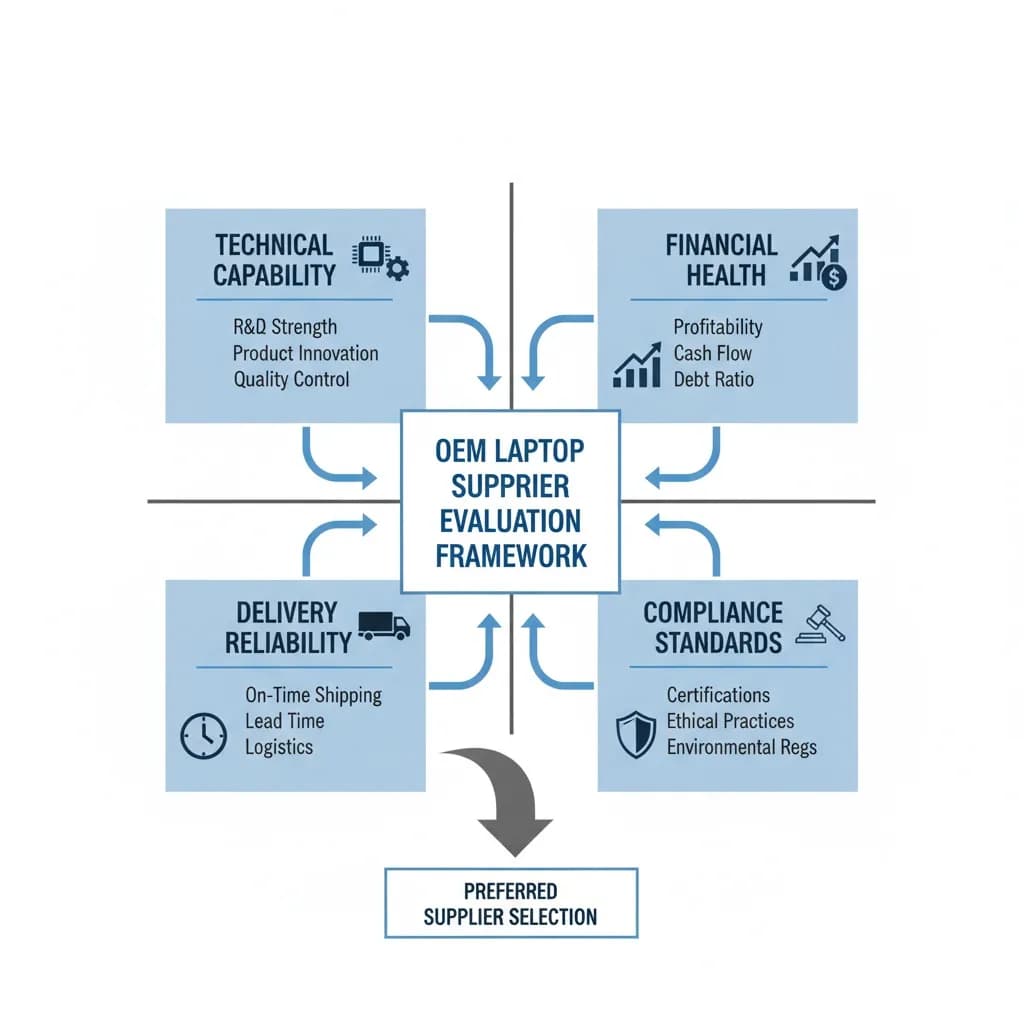
This article will provide you with a complete OEM laptop supplier evaluation framework, including detailed screening criteria, evaluation form templates, and implementation processes to help you establish a reliable supply chain system. Whether you are looking for suppliers for new projects or hoping to optimize existing supplier management systems, this set of practice-proven methods can provide valuable guidance.
By reading this article, you will learn how to comprehensively evaluate suppliers from multiple dimensions including technical capabilities, financial status, delivery reliability, and compliance standards, and obtain directly usable evaluation form templates that allow you to immediately start applying these best practices.
Table of Contents
- What are the Core Dimensions of OEM Supplier Evaluation?
- How to Design Effective Supplier Screening Criteria?
- How Should Practical OEM Laptop Evaluation Forms be Constructed?
- What is the Best Process for Supplier Evaluation Implementation?
- How to Continuously Monitor and Optimize Supplier Performance?
1. What are the Core Dimensions of OEM Supplier Evaluation?
Technical Capability Assessment: The Core Competitiveness of Suppliers
Technical capability is the primary consideration when evaluating OEM laptop suppliers. Excellent suppliers should possess advanced production processes, strong R&D capabilities, and comprehensive quality control systems. When assessing technical capabilities, you need to focus on the supplier's production line automation level, advanced testing equipment, and whether they have autonomous production capabilities for key components.
Specifically, technical capability assessment includes: maturity and stability of production processes, ensuring product consistency; size and experience of R&D teams, including engineers' qualifications and past project experience; completeness of quality control systems, covering full-process quality control measures from raw material inspection to finished product delivery; technological innovation capabilities, including exploration and application of new materials and processes.
In terms of production processes, focus on evaluating suppliers' Surface Mount Technology (SMT) capabilities, precision assembly processes, and testing and calibration procedures. Advanced SMT production lines should have high-precision pick-and-place machines, reflow ovens, automatic optical inspection equipment, etc. For laptop manufacturing, suppliers need precision mechanical assembly capabilities, including housing processing, screen installation, keyboard assembly, and other processes.
R&D capability assessment should look not only at personnel numbers but also at the professional backgrounds and project experience of R&D teams. An ideal R&D team should include structural engineers, electronic engineers, software engineers, test engineers, and other professional fields. Additionally, understand the supplier's R&D investment as a percentage of revenue, which reflects their emphasis on technological innovation.
Quality control systems are key to ensuring product quality. Suppliers should establish comprehensive quality management systems, including Incoming Quality Control (IQC), In-Process Quality Control (IPQC), Final Quality Control (FQC), and Outgoing Quality Control (OQC). Particularly important is understanding suppliers' testing capabilities for key components and finished products, such as environmental testing, reliability testing, and performance testing.
A trustworthy supplier should be able to show you complete technical documentation, including process flow charts, quality control standards, and test reports. Additionally, on-site inspection of production facilities to personally observe production line operations and worker operational compliance is an important part of technical capability assessment. During on-site inspections, pay special attention to 5S management conditions at production sites, equipment maintenance records, and employee skill training records.
Financial Health Status: Important Indicator of Supplier Stability
Suppliers' financial status directly relates to supply chain stability and continuity. A supplier with poor financial conditions may not guarantee long-term stable supply and may even experience operational crises during cooperation. Therefore, comprehensive financial assessment is an indispensable part of the supplier screening process.
Key financial assessment indicators include: asset-liability ratio, reflecting suppliers' debt levels and financial risks; cash flow conditions, particularly the stability of operating cash flows; profitability indicators, such as trends in gross margin and net margin; accounts receivable and inventory turnover rates, reflecting operational efficiency; bank credit ratings and financing capabilities, demonstrating financial institutions' recognition of suppliers.
In terms of assets and liabilities, pay special attention to suppliers' capital structure and debt-paying ability. A healthy asset-liability ratio should typically be controlled below 70%; excessive debt ratios increase financial risks. Current ratio and quick ratio are important indicators for assessing short-term debt-paying ability; current ratio should be maintained above 1.2, and quick ratio should be above 1.0.
Profitability analysis should look not only at absolute values but also at the stability and growth trends of profitability. Gross margin reflects suppliers' cost control capabilities and product competitiveness, while net margin reflects overall operational management levels. For manufacturing enterprises, gross margin should generally be maintained above 15%, and net margin should be above 5%.
Cash flow is key to assessing financial health. Positive and steadily growing operating cash flows indicate healthy main business operations. Investment activity cash flows reflect enterprise expansion investments, while financing activity cash flows demonstrate financing capabilities. A healthy cash flow structure should have positive operating cash flows that can support investment and financing activities.
When analyzing financial data, focus not only on current financial conditions but also analyze historical trends to understand the direction of financial condition changes. It's recommended to obtain at least three years of financial statements from suppliers to analyze trends in key indicators. Additionally, comparing suppliers' financial indicators with industry average levels can help you more accurately judge their financial health.
Besides financial statement analysis, attention should also be paid to suppliers' bank credit ratings, tax records, legal litigation situations, and other non-financial information. This information can help you more comprehensively assess suppliers' financial risks and operational stability.
Delivery Reliability: Ensuring Smooth Supply Chain Operations
Delivery capability is an important indicator of whether suppliers can meet your business needs. Even if suppliers are technically advanced and financially healthy, if they cannot deliver products on time and in quantity, it will seriously impact your business. Delivery reliability assessment requires comprehensive consideration from multiple dimensions.
Core assessment indicators include: capacity scale matching with your needs, whether suppliers have sufficient production capacity to meet your order requirements; production planning flexibility, ability to respond to your urgent orders or demand changes; logistics network coverage, particularly whether they can effectively serve your target markets; delivery cycle stability, degree of deviation between actual delivery time and promised time; emergency response mechanisms, handling capabilities when facing unexpected situations.
Capacity assessment is the core of delivery capability analysis. Detailed understanding of suppliers' design capacity, actual capacity, and capacity utilization rates is essential. Ideally, suppliers' capacity utilization should be maintained between 60%-85%, ensuring both economies of scale and sufficient capacity buffer to handle order fluctuations. For key products, suppliers should have multiple production lines or backup capacity to avoid single-point failure risks.
Production planning and scheduling capabilities directly affect delivery timeliness. Excellent suppliers should have advanced production planning systems (such as APS, ERP) that can optimize production scheduling and improve equipment utilization. Additionally, assess suppliers' supply chain management capabilities, including coordination of raw material procurement, inventory management, and production scheduling.
Logistics and distribution capabilities are also important aspects of assessing delivery reliability. Understand suppliers' warehousing networks, transportation capabilities, and packaging technologies. For cross-border procurement, also assess suppliers' international logistics experience, including customs clearance capabilities, international transportation networks, and overseas warehousing facilities.
Emergency response mechanisms are key to ensuring delivery continuity. Suppliers should establish comprehensive emergency plans, including equipment failure responses, raw material shortage handling, and personnel deployment plans. Additionally, assess suppliers' emergency communication mechanisms to ensure timely notification and coordination in unexpected situations.
To accurately assess delivery capabilities, it's recommended that you request suppliers to provide delivery records for the past 12 months, including key data such as on-time delivery rates and order completion rates. Additionally, understanding suppliers' capacity utilization and production schedules can help you judge whether they have sufficient capacity to carry your business. On-site inspection of suppliers' production sites is recommended to understand actual production organization capabilities and logistics operations.
Compliance and Certification: Basic Requirements for Industry Entry

In the electronics manufacturing industry, various certifications and compliance requirements are basic qualifications that suppliers must possess. These certifications not only reflect suppliers' professional levels but are also important guarantees for ensuring products meet international standards. Comprehensive review of suppliers' certification status can reduce compliance risks and improve product quality.
Key certifications include: ISO 9001 quality management system certification, which is the basic requirement for quality management; ISO 14001 environmental management system certification, reflecting suppliers' environmental responsibilities; industry-specific certifications, such as IPC certification and UL certification in the electronics industry; social responsibility certifications, such as SA8000 or BSCI certification, reflecting suppliers' performance in labor rights protection; information security certifications, such as ISO 27001, which are important for protecting business secrets.
ISO 9001 quality management system certification is a basic requirement for evaluating suppliers. This certification requires suppliers to establish comprehensive quality management systems, including quality policies, quality objectives, process control, and continuous improvement elements. Pay special attention to the authority of certification bodies and the validity of certification scope, ensuring certification covers your purchased product categories and production processes.
For the electronics manufacturing industry, industry-specific certifications are particularly important. IPC (Institute for Printed Circuits) certifications include IPC-A-610 (Acceptability of Electronic Assemblies), IPC-6012 (Qualification and Performance Specification for Rigid Printed Boards), and other standards. UL certification involves product safety performance, particularly for electronic products sold in North American markets that must have relevant UL certifications.
Environmental management and social responsibility certifications are receiving increasing attention. ISO 14001 environmental management system certification requires suppliers to establish environmental management systems and control environmental pollution. Environmental compliance requirements such as EPEAT, RoHS, and REACH also need key attention. Social responsibility certifications such as SA8000 and BSCI assess suppliers' performance in labor rights, working conditions, and health and safety.
Information security certification has become particularly important in the current digital age. ISO 27001 information security management system certification requires suppliers to establish comprehensive information security management systems to protect business secrets and customer data. For suppliers involving sensitive technologies, this certification is particularly critical.
When verifying certifications, not only check certificate validity but also pay attention to whether certification scope covers your purchased product categories. Additionally, understand suppliers' internal compliance management systems, including dedicated compliance team setup and regular audit mechanisms, which can reflect suppliers' emphasis on compliance work.
Evaluation Dimension Comparison Table
| Evaluation Dimension | Key Indicators | Recommended Weight | Assessment Method |
|---|---|---|---|
| Technical Capability | Production processes, R&D strength, quality control | 30% | Document review, site inspection, sample testing |
| Financial Health | Asset-liability ratio, cash flow, profitability | 25% | Financial statement analysis, credit rating inquiry |
| Delivery Capability | Capacity scale, on-time delivery rate, logistics network | 25% | Historical data, capacity verification, site inspection |
| Compliance Certification | ISO certification, industry qualifications, social responsibility | 20% | Certificate verification, compliance system audit |
Chapter Self-Test Questions
-
When evaluating OEM supplier technical capabilities, which factor is most important?
A. Production scale size
B. Price competitiveness
C. Quality control system completeness
D. Establishment time length -
In supplier financial assessment, which indicator best reflects short-term debt-paying ability?
A. Net profit margin
B. Asset-liability ratio
C. Current ratio
D. Accounts receivable turnover -
ISO 9001 certification mainly covers which management area?
A. Environmental management
B. Quality management
C. Information security management
D. Financial management

2. How to Design Effective Supplier Screening Criteria?
Establishing Weight Systems: Scientific Allocation of Assessment Weights
The first step in designing supplier screening criteria is establishing a reasonable weight system. Different evaluation dimensions have varying importance to your business, so weights need to be allocated based on specific needs and risk preferences. A scientific weight system can ensure objective and fair evaluation results, avoiding the impact of subjective factors on decision-making.
Basic principles for weight allocation include: consistency with business strategy, weight allocation should reflect your enterprise's strategic priorities; risk-oriented principle, allocating higher weights to high-risk areas; cost-benefit considerations, balancing assessment costs with assessment depth; dynamic adjustment mechanisms, adjusting weight allocation based on market changes and business needs.
A practical weight system framework suggests: technical capability accounting for 30%, reflecting the decisive role of technological innovation on product quality; financial health accounting for 25%, reflecting the importance of supply chain stability; delivery capability accounting for 25%, ensuring business continuity; compliance certification accounting for 20%, ensuring compliance with industry and regulatory requirements.
In practical applications, you can adjust weight allocation based on specific project characteristics. For example, for high-end product projects, the weight of technical capability may need to increase to 35%; while for bulk procurement projects, the weights of cost and delivery capability may be more important.
Setting Quantitative Indicators: Making Assessment Measurable and Comparable
Effective screening criteria must be based on quantifiable indicators. Vague descriptive criteria lead to subjective and arbitrary evaluation results lacking comparability. By setting specific quantitative indicators, you can objectively compare different suppliers' performance and make more rational decisions.
Key points for quantitative indicator design: specific and clear, each indicator should have clear definitions and calculation methods; measurability, indicator data should be obtainable through objective means; relevance, indicators should be directly related to performance dimensions you care about; timeliness, data should be obtainable in a timely manner, reflecting the latest situation.
Key quantitative indicator examples:
Technical Capability Indicators
- R&D investment ratio: R&D expenses as percentage of operating revenue (recommended >8%)
- Engineer ratio: Technical personnel as percentage of total employees (recommended >15%)
- Patent quantity: Number of patents obtained in the past 3 years
- Quality incident rate: Number of quality incidents per million products (recommended <100ppm)
In technical capability indicator setting, special attention needs to be paid to industry specificity. For laptop OEM manufacturing, R&D investment is not just about the amount of expense investment, but more about the direction and effectiveness of investment. Excellent suppliers should have continuous investment in new material applications, production process improvements, and product design innovations. Patent indicators should look not only at quantity but also at patent quality and relevance; core patents are more valuable than peripheral patents.
Financial Health Indicators
- Asset-liability ratio: Total liabilities/Total assets (recommended <70%)
- Current ratio: Current assets/Current liabilities (recommended >1.2)
- Gross margin: Gross profit/Operating revenue (recommended >15%)
- Cash flow coverage ratio: Operating cash flow/Short-term debt (recommended >1.0)
Financial indicator setting needs to consider industry characteristics. Manufacturing typically has relatively low gross margins but high turnover rates. Reasonable thresholds should be set in combination with industry average levels. Cash flow indicators better reflect actual business conditions than simple profit indicators, especially during economic fluctuations.
Delivery Capability Indicators
- On-time delivery rate: On-time delivered orders/Total orders (recommended >95%)
- Capacity utilization rate: Actual capacity/Design capacity (recommended 60%-85%)
- Order completion cycle: Average days from order receipt to delivery
- Inventory turnover rate: Annual cost of goods sold/Average inventory (recommended >6 times)
Delivery capability indicators should consider product complexity and customization levels. Standardized products should have shorter delivery cycles, while customized products need reasonable production cycles. Too low capacity utilization may reflect insufficient business, while too high may affect delivery flexibility; balance needs to be found between efficiency and flexibility.
Besides these basic indicators, service response indicators should also be set, such as technical support response time (recommended <2 hours), customer satisfaction scores (recommended >4.5/5 points), training completion rates, etc. Although these soft indicators are difficult to quantify, they are equally important for long-term cooperative relationships.
Tiered Assessment Mechanisms: Differentiated Treatment of Different Suppliers
Not all suppliers need the same intensity of assessment. Establishing tiered assessment mechanisms can help you more effectively allocate assessment resources and focus on the most important suppliers. Tiered assessment can ensure assessment depth for key suppliers while avoiding over-investment in secondary suppliers.
Tiering criteria can be based on multiple dimensions: procurement amount proportion, suppliers with annual procurement exceeding certain thresholds need deeper assessment; strategic importance, suppliers with significant impact on core business should be key assessment targets; supply risk, categories with fewer alternative suppliers need stricter assessment; technical complexity, suppliers of high-tech products need more detailed assessment.
Recommended tiering system:
A-level Suppliers (Key Assessment)
- Procurement amount >10 million yuan/year
- Strategic core product suppliers
- Assessment cycle: Quarterly
- Assessment depth: Comprehensive on-site audit
B-level Suppliers (Regular Assessment)
- Procurement amount 1-10 million yuan/year
- Important product suppliers
- Assessment cycle: Semi-annually
- Assessment depth: On-site sampling + document review
C-level Suppliers (Simplified Assessment)
- Procurement amount <1 million yuan/year
- General product suppliers
- Assessment cycle: Annually
- Assessment depth: Document review primarily
Risk Warning Mechanisms: Early Identification of Potential Risks
Excellent supplier screening criteria should include not only static assessment but also dynamic risk warning mechanisms. By continuously monitoring changes in key indicators, you can identify potential risks early, take preventive measures, and avoid losses.
Risk warning indicator design: financial risk warning, monitoring deterioration trends in key financial indicators; operational risk warning, focusing on abnormal changes in quality, delivery, and other operational indicators; compliance risk warning, tracking certification status and regulatory compliance; market risk warning, monitoring industry dynamics and competitive environment changes.
Warning threshold setting principles: based on historical data, analyzing suppliers' historical performance data; industry benchmarks, referencing industry average levels and best practices; risk preferences, setting based on your enterprise's risk tolerance; dynamic adjustment, adjusting threshold settings based on actual warning effectiveness.
Warning response mechanisms: Level 1 warning (minor), strengthen monitoring, increase reporting frequency; Level 2 warning (moderate), initiate investigation, develop response plans; Level 3 warning (severe), consider alternative plans, activate emergency plans.
Supplier Screening Criteria Weight Table Example
| Evaluation Dimension | Primary Indicator | Weight | Scoring Criteria | Data Source |
|---|---|---|---|---|
| Technical Capability | R&D Strength | 10% | R&D investment >8% gets full score, deduct 10 points for each 1% decrease | Financial statements |
| Production Process | 12% | Automation rate >80% gets full score | On-site audit | |
| Quality Control | 8% | ISO9001 certification + 6Sigma implementation gets full score | Certificates + documents | |
| Financial Health | Profitability | 10% | Gross margin >15% gets full score | Financial statements |
| Debt-paying Ability | 8% | Asset-liability ratio <70% gets full score | Financial statements | |
| Cash Flow | 7% | Cash flow coverage ratio >1.0 gets full score | Financial statements | |
| Delivery Capability | On-time Delivery | 15% | On-time rate >95% gets full score | Historical data |
| Capacity Scale | 10% | Capacity meets demand gets full score | Capacity verification | |
| Compliance Certification | Quality Certification | 12% | ISO9001 + industry certification gets full score | Certificate verification |
| Environmental Certification | 5% | ISO14001 certification gets full score | Certificate verification | |
| Social Responsibility | 3% | SA8000 certification gets full score | Certificate verification |
Chapter Self-Test Questions
-
In supplier evaluation weight systems, which allocation method is most reasonable?
A. Equal weight allocation for all dimensions
B. Differentiated allocation based on business importance
C. Mainly considering price factors
D. Only focusing on technical capability -
Which indicator is most suitable for evaluating suppliers' short-term debt-paying ability?
A. Net profit margin
B. Current ratio
C. Asset turnover ratio
D. Gross margin -
For strategic suppliers with annual procurement exceeding 10 million yuan, what is the recommended assessment frequency?
A. Monthly
B. Quarterly
C. Semi-annually
D. Annually

3. How Should Practical OEM Laptop Evaluation Forms be Constructed?
Basic Information Module: Comprehensive Understanding of Supplier Background
The first step in constructing evaluation forms is designing a comprehensive basic information module. This module aims to collect suppliers' basic background information, providing foundational information for your subsequent in-depth evaluation. A well-structured basic information module should cover suppliers' enterprise overview, business scale, development history, and other key information.
Core fields of the basic information module include: enterprise basic information (company name, establishment time, registered capital, legal representative, etc.); business scale information (annual operating revenue, total employees, production base area, etc.); organizational structure information (department setup, management structure, decision-making processes, etc.); development history information (important milestones, business development stages, future plans, etc.); customer group information (main customer types, customer concentration, customer feedback, etc.).
In form design, it's recommended to use standardized field formats to ensure consistency in information collection. For numerical fields, clarify unit requirements; for date fields, unify format specifications; for selection fields, provide complete option lists. Such standardized design can improve the efficiency and accuracy of data collection.
Supplier Basic Information Table Example
| Information Category | Specific Item | Content Record | Verification Method | Assessment Result |
|---|---|---|---|---|
| Enterprise Basic Info | Company Name | Business License | ||
| Establishment Date | Business License | |||
| Registered Capital | Business License | |||
| Business Scope | Business License | |||
| Business Scale | Annual Revenue | Financial Statements | ||
| Total Employees | Social Security Proof | |||
| Number of Production Bases | Site Inspection | |||
| Number of Production Lines | Site Inspection | |||
| Technical Capability | Number of R&D Personnel | Personnel Files | ||
| Number of Patents Held | Patent Certificates | |||
| Main Production Equipment | Equipment List | |||
| Quality Testing Equipment | Equipment List |
Technical Assessment Module: In-depth Analysis of Technical Strength
The technical assessment module is the core part of OEM laptop supplier evaluation forms, requiring comprehensive reflection of suppliers' technical strength and innovation capabilities. This module's design should balance depth and breadth, having both quantitative technical indicators and qualitative technical evaluations.
Key content of the technical assessment module includes: R&D capability assessment (R&D team scale, R&D investment ratio, technical patent situation); production process assessment (production line automation level, process advancement, production capacity); quality control assessment (quality management system, testing equipment, quality standards); product technology assessment (product specifications, performance indicators, technological innovation capability); technical support assessment (technical service team, problem response capability, technical training capability).
When designing technical assessment forms, it's recommended to use layered assessment methods. The first layer is basic technical capability assessment, including basic requirements that must be met; the second layer is technical advantage assessment, identifying suppliers' technical strengths and competitive advantages; the third layer is technological innovation assessment, evaluating suppliers' technological development potential.
Technical Capability Assessment Table Example
| Technical Category | Assessment Item | Assessment Criteria | Score | Notes |
|---|---|---|---|---|
| R&D Capability | R&D Personnel Ratio | >15%:5 points, 10-15%:3 points, <10%:1 point | ||
| R&D Investment Ratio | >8%:5 points, 5-8%:3 points, <5%:1 point | |||
| Annual New Patents | >10:5 points, 5-10:3 points, <5:1 point | |||
| Production Process | Automation Rate | >80%:5 points, 60-80%:3 points, <60%:1 point | ||
| Equipment Advancement | International advanced:5 points, Domestic advanced:3 points, General:1 point | |||
| Process Stability | Yield rate >99%:5 points, 97-99%:3 points, <97%:1 point | |||
| Quality Control | Quality System Certification | ISO9001+industry certification:5 points, ISO9001 only:3 points | ||
| Testing Equipment Completeness | Complete:5 points, Basically complete:3 points, Incomplete:1 point | |||
| Quality Incident Rate | <50ppm:5 points, 50-100ppm:3 points, >100ppm:1 point |
Commercial Terms Module: Ensuring Reasonable Cooperation Terms
The commercial terms module mainly evaluates suppliers' business conditions and cooperation terms, which is crucial for establishing long-term stable cooperative relationships. This module should cover key commercial elements such as pricing terms, delivery conditions, service commitments, and breach of contract responsibilities.
Core content of commercial terms assessment: price competitiveness assessment (price level, price stability, cost transparency); payment condition assessment (payment cycle, payment method, credit terms); delivery condition assessment (delivery period, minimum order quantity, delivery method); service terms assessment (after-sales service, technical support, training services); risk sharing assessment (quality assurance, breach of contract responsibility, dispute resolution).
When designing commercial terms assessment forms, it's recommended to use a total score structure. First assess the reasonableness of various terms, then comprehensively evaluate the competitiveness of overall commercial conditions. Additionally, consider the matching degree between commercial terms and your enterprise's procurement policies to ensure cooperation complies with internal management requirements.
Commercial Terms Assessment Table Example
| Terms Category | Assessment Item | Assessment Criteria | Market Comparison | Score |
|---|---|---|---|---|
| Pricing Terms | Price Level | Comparison with market prices | 5% below market:5 points, Equal:3 points, Above market:1 point | |
| Price Stability | Annual price fluctuation | <3%:5 points, 3-5%:3 points, >5%:1 point | ||
| Cost Transparency | Cost structure clarity | Transparent:5 points, Partially transparent:3 points, Opaque:1 point | ||
| Payment Conditions | Payment Cycle | Account period days | >60 days:5 points, 30-60 days:3 points, <30 days:1 point | |
| Payment Method | Payment method flexibility | Flexible:5 points, Relatively flexible:3 points, Fixed:1 point | ||
| Delivery Conditions | Delivery Period | Standard delivery period | <30 days:5 points, 30-45 days:3 points, >45 days:1 point | |
| Minimum Order Quantity | MOQ reasonableness | Flexible:5 points, Reasonable:3 points, Strict:1 point |
Risk Assessment Module: Identifying and Managing Potential Risks
The risk assessment module is an important component of supplier evaluation forms, used to identify and assess various risks that may be faced when cooperating with suppliers. This module should cover multiple dimensions including financial risks, operational risks, compliance risks, and market risks.
Key content of risk assessment includes: financial risk assessment (financial condition stability, debt-paying ability, profitability); operational risk assessment (production continuity, quality control stability, delivery reliability); compliance risk assessment (regulatory compliance, certification validity, social responsibility); market risk assessment (industry position, competitive environment, market change adaptability); reputation risk assessment (brand image, customer satisfaction, public opinion monitoring).
When designing risk assessment forms, it's recommended to use risk matrix methods, comprehensively considering the probability of risk occurrence and impact degree. For high-risk items, detailed response measures and monitoring plans need to be developed.
Risk Assessment Table Example
| Risk Category | Risk Item | Occurrence Probability | Impact Degree | Risk Level | Response Measures |
|---|---|---|---|---|---|
| Financial Risk | Capital chain break | Low | High | Medium | Regular financial monitoring |
| Exchange rate fluctuation | Medium | Medium | Medium | Exchange rate lock clauses | |
| Operational Risk | Production interruption | Low | High | Medium | Diversified supply |
| Quality decline | Medium | High | High | Strengthen quality monitoring | |
| Compliance Risk | Certification expiry | Low | High | Medium | Certification validity tracking |
| Environmental violations | Low | Medium | Low | Regular compliance audits | |
| Market Risk | Raw material price increase | High | Medium | High | Price adjustment mechanism |
| Technology lag | Medium | High | Medium | Technology upgrade tracking |
Comprehensive Assessment Module: Forming Overall Evaluation Conclusions
The comprehensive assessment module is the summary part of evaluation forms, used to integrate evaluation results from various modules and form overall evaluation conclusions for suppliers. This module should include score summaries, advantage and disadvantage analysis, cooperation recommendations, and other key content.
Main content of comprehensive assessment includes: comprehensive score calculation (weighted summary of scores from various modules); advantage analysis (suppliers' core competitiveness and outstanding advantages); disadvantage analysis (suppliers' shortcomings and improvement areas); cooperation recommendations (whether to recommend cooperation and cooperation conditions); risk alerts (risk points requiring key attention).
In the comprehensive assessment module, it's recommended to use clear rating standards, such as Excellent (above 90 points), Good (80-89 points), Qualified (70-79 points), Needs Improvement (60-69 points), Unqualified (below 60 points). Additionally, provide clear action recommendations for each rating.
Comprehensive Assessment Report Template
| Assessment Item | Score | Weight | Weighted Score | Rating |
|---|---|---|---|---|
| Basic Information | 85 | 10% | 8.5 | Good |
| Technical Capability | 90 | 30% | 27.0 | Excellent |
| Commercial Terms | 80 | 25% | 20.0 | Good |
| Risk Assessment | 75 | 20% | 15.0 | Qualified |
| Cooperation History | 85 | 15% | 12.8 | Good |
| Comprehensive Score | 100% | 83.3 | Good |
Main Advantages:
- Strong technical strength with high R&D investment ratio
- Advanced production processes with comprehensive quality control systems
- Stable delivery capability with 96% on-time delivery rate
Main Disadvantages:
- Relatively strict commercial terms with inflexible payment conditions
- Certification coverage needs further expansion
Cooperation Recommendation:
✅ Recommend cooperation, suggest focusing on quality control and delivery progress
Chapter Self-Test Questions
-
In the supplier basic information module, what is the most important verification item?
A. Company promotional materials
B. Business license and financial statements
C. Website information
D. Recommendation materials -
In technical capability assessment, which indicator best reflects suppliers' innovation strength?
A. Number of production equipment
B. Annual number of new patents
C. Total number of employees
D. Office area -
In the risk assessment module, what measures should be taken for high-risk areas?
A. Ignore them
B. Develop detailed response measures and monitoring plans
C. Only record for filing
D. Wait for problems to appear before handling
4. What is the Best Process for Supplier Evaluation Implementation?
Preparation Phase: Laying the Foundation for Evaluation Work
The success of supplier evaluation largely depends on the adequacy of preparation work. A comprehensive preparation phase can ensure orderly evaluation work, avoid missing key links, and improve the efficiency and quality of evaluation work. The core tasks of the preparation phase are to clarify evaluation objectives, form evaluation teams, and develop detailed evaluation plans.
Specific work content of the preparation phase includes: clarifying evaluation needs, determining evaluation scope and depth based on business needs; forming evaluation teams, including professionals from procurement, technology, quality, finance, and other areas; developing evaluation standards, creating targeted evaluation standards based on business characteristics; compiling evaluation plans, clarifying time nodes, responsibility division, and resource allocation; preparing evaluation tools, designing evaluation forms, checklists, and other tools; training evaluation personnel, ensuring teams have consistent understanding of evaluation standards and processes.
When forming evaluation teams, it's recommended to use cross-functional team approaches. Ideal teams should include: procurement experts (responsible for commercial negotiations and supply chain management), technical experts (responsible for technical capability assessment), quality experts (responsible for quality system assessment), financial experts (responsible for financial condition analysis), and legal experts (responsible for compliance risk review). Each team member should have relevant professional knowledge and practical experience.
Evaluation Preparation Phase Checklist
| Work Item | Specific Content | Completion Status | Responsible Person | Completion Time |
|---|---|---|---|---|
| Need Clarification | Evaluation objective determination | ☐ Complete | ||
| Evaluation scope definition | ☐ Complete | |||
| Evaluation depth requirements | ☐ Complete | |||
| Team Formation | Evaluation team composition | ☐ Complete | ||
| Role responsibility allocation | ☐ Complete | |||
| Communication mechanism establishment | ☐ Complete | |||
| Standard Development | Evaluation standard determination | ☐ Complete | ||
| Weight system design | ☐ Complete | |||
| Scoring rule development | ☐ Complete | |||
| Tool Preparation | Evaluation form design | ☐ Complete | ||
| Checklist compilation | ☐ Complete | |||
| Site inspection plan | ☐ Complete |
Execution Phase: Comprehensive Collection of Evaluation Information
The execution phase is the core link of supplier evaluation, requiring collection of detailed supplier information through various means and conducting preliminary analysis and verification. The work quality of the execution phase directly determines the accuracy and reliability of evaluation results.
Main work of the execution phase includes: information collection, collecting supplier information through questionnaires, interviews, site inspections, and other methods; document review, reviewing various qualification documents and reports provided by suppliers; site inspection, visiting production bases on-site to understand actual operational conditions; technical assessment, conducting in-depth assessment of suppliers' technical capabilities; sample testing, conducting strict testing of product samples provided by suppliers; customer interviews, communicating with suppliers' other customers to understand cooperation experiences.
During information collection, special attention should be paid to the authenticity and accuracy of information. For information provided by suppliers themselves, verification should be conducted through multiple channels. Site inspection is an important means of verifying information authenticity; through on-site observation of production sites, checking quality records, and interviewing front-line employees, more authentic and reliable information can be obtained.
Site Inspection Key Points Checklist
Production Site Inspection
- Production line layout rationality and cleanliness
- Equipment maintenance conditions and operating status
- Worker operational compliance and skill levels
- Quality control measures for work-in-progress
- Production process smoothness and efficiency
Quality System Inspection
- Quality testing laboratory equipment and capabilities
- Quality record completeness and standardization
- Non-conforming product handling processes
- Quality improvement implementation
- Customer complaint handling mechanisms
Technical Capability Inspection
- R&D laboratory equipment and projects
- Technical personnel qualifications and experience
- Process document management and updates
- New product development processes and cycles
- Technical problem-solving capabilities
Assessment Phase: Comprehensive Analysis of Evaluation Results
The assessment phase is the process of systematically analyzing collected information and forming comprehensive evaluations of suppliers. This phase requires using scientific assessment methods to ensure objectivity and accuracy of evaluation results.
Key work of the assessment phase includes: data organization, classifying and organizing various collected information; score calculation, conducting quantitative scoring of suppliers based on evaluation standards; advantage analysis, identifying suppliers' core competitive advantages; disadvantage analysis, finding suppliers' shortcomings; risk assessment, assessing potential risks of cooperating with suppliers; comprehensive evaluation, forming overall evaluation conclusions for suppliers.
During score calculation, it's recommended to use multi-dimensional scoring methods. First conduct individual item scoring, then calculate category scores, and finally obtain comprehensive scores. To ensure scoring fairness, it's recommended to use multi-person scoring methods, calculating average scores to reduce subjective bias. For important indicators, one-vote veto conditions can be set to ensure key requirements are met.
Supplier Scoring Calculation Example
| Evaluation Dimension | Weight | Scorer A | Scorer B | Scorer C | Average Score | Weighted Score |
|---|---|---|---|---|---|---|
| Technical Capability | 30% | 85 | 90 | 88 | 87.7 | 26.3 |
| Financial Health | 25% | 80 | 78 | 82 | 80.0 | 20.0 |
| Delivery Capability | 25% | 90 | 85 | 88 | 87.7 | 21.9 |
| Compliance Certification | 20% | 95 | 90 | 92 | 92.3 | 18.5 |
| Comprehensive Score | 100% | 86.7 |
Follow-up Phase: Ensuring Evaluation Results Implementation
The completion of evaluation work does not mean the end of the evaluation process. The follow-up phase is the key link to ensure evaluation results are effectively applied and supplier performance is continuously improved. An effective follow-up mechanism can transform evaluation results into actual supply chain improvements.
Main work of the follow-up phase includes: result feedback, providing detailed feedback of evaluation results to suppliers; improvement plan development, assisting suppliers in developing targeted improvement plans; implementation tracking, regularly tracking improvement plan implementation progress; effect verification, verifying actual effects of improvement measures; regular re-evaluation, regularly re-assessing supplier performance; relationship optimization, optimizing supplier relationship management based on evaluation results.
When communicating evaluation results with suppliers, constructive approaches should be used. First acknowledge suppliers' advantages and achievements, then objectively point out areas needing improvement, and finally jointly develop improvement plans. This communication approach can maintain good cooperative relationships while promoting suppliers' continuous improvement.
Evaluation Result Feedback Template
Overall Evaluation Results:
- Comprehensive Score: XX points (Rating: Excellent/Good/Qualified/Needs Improvement)
- Main Advantages: [List 2-3 core advantages]
- Main Improvement Points: [List 2-3 key improvement areas]
Detailed Feedback Content:
-
Technical Capability Aspects
- Advantages: [Specific advantage descriptions]
- Improvement Suggestions: [Specific improvement suggestions]
-
Financial Health Aspects
- Advantages: [Specific advantage descriptions]
- Improvement Suggestions: [Specific improvement suggestions]
-
Delivery Capability Aspects
- Advantages: [Specific advantage descriptions]
- Improvement Suggestions: [Specific improvement suggestions]
-
Compliance Certification Aspects
- Advantages: [Specific advantage descriptions]
- Improvement Suggestions: [Specific improvement suggestions]
Improvement Plan Requirements:
- Please submit detailed improvement plan within 30 days
- Improvement plan should include specific measures, responsible persons, completion times
- We will track improvement progress quarterly
Supplier Evaluation Implementation Timeline Example
| Phase | Work Content | Time Arrangement | Deliverables | Responsible Person |
|---|---|---|---|---|
| Preparation Phase | Need clarification, team formation | Week 1 | Evaluation plan, evaluation standards | Procurement Manager |
| Standard development, tool preparation | Week 2 | Evaluation forms, checklists | Procurement Specialist | |
| Execution Phase | Information collection, document review | Weeks 3-4 | Supplier files | Evaluation Team |
| Site inspection, sample testing | Weeks 5-6 | Inspection reports, test reports | Technical Team | |
| Assessment Phase | Data analysis, score calculation | Week 7 | Evaluation report | Analysis Team |
| Comprehensive evaluation, conclusion formation | Week 8 | Comprehensive evaluation conclusion | Procurement Manager | |
| Follow-up Phase | Result feedback, improvement plan | Week 9 | Feedback records | Procurement Specialist |
| Regular tracking, effect verification | Ongoing | Tracking reports | Supplier Management |
Chapter Self-Test Questions
-
When forming supplier evaluation teams, what should the ideal personnel composition include?
A. Only procurement personnel
B. Cross-functional professional teams
C. External consultants
D. Senior management personnel -
During site inspections, what is the most important verification aspect?
A. Office environment
B. Actual production operational conditions
C. Number of employees
D. Geographic location -
What approach should be used for evaluation result feedback?
A. Only point out problems
B. Constructive communication, acknowledging advantages and proposing improvement suggestions
C. No feedback to suppliers
D. Only inform final conclusions

5. How to Continuously Monitor and Optimize Supplier Performance?
KPI System Construction: Quantifying Supplier Performance Monitoring
Establishing a scientific KPI system is the foundation for continuously monitoring supplier performance. An effective KPI system can quantify suppliers' various performance indicators, provide data support for objectively evaluating supplier performance, and help you identify problems timely and take improvement measures.
Key principles for KPI system design: relevance principle, indicators should be directly related to performance dimensions you care about; measurability principle, indicator data should be objectively obtainable and quantifiable; balance principle, covering all dimensions including quality, delivery, cost, and service; timeliness principle, data should timely reflect latest performance; comparability principle, indicators should enable historical comparison and inter-supplier comparison.
Core KPI indicator recommendations:
Quality KPIs
- Product qualification rate: Number of qualified products/Total products (target >99%)
- Customer complaint rate: Number of complaints/Total orders (target <1%)
- Quality incident response time: Average time from incident occurrence to response (target <2 hours)
- Rework rate: Proportion of products requiring rework (target <0.5%)
Delivery KPIs
- On-time delivery rate: On-time delivered orders/Total orders (target >95%)
- Order completion cycle: Average days from order receipt to delivery
- Emergency order response capability: Fulfillment rate for emergency orders (target >90%)
- Delivery accuracy: Accuracy of order specifications and quantities (target >99%)
Cost KPIs
- Price competitiveness: Comparison with market prices
- Cost reduction magnitude: Annual cost reduction percentage (target >3%)
- Price stability: Price fluctuation magnitude (target <5%)
- Total cost of ownership: Including procurement costs, usage costs, maintenance costs
Service KPIs
- Technical support response time: Average response time for technical issues
- Customer satisfaction: Customer satisfaction survey scores (target >4.5/5)
- Training effectiveness assessment: Employee skill improvement after training
- Innovation contribution: Number of improvement suggestions provided by suppliers
Supplier KPI Monitoring Dashboard Example
| KPI Category | Specific Indicator | Target Value | Actual Value | Achievement Rate | Trend |
|---|---|---|---|---|---|
| Quality Performance | Product qualification rate | >99% | 99.2% | 100% | ↗️ |
| Customer complaint rate | <1% | 0.8% | 100% | ↘️ | |
| Delivery Performance | On-time delivery rate | >95% | 96.5% | 100% | ↗️ |
| Order cycle | <30 days | 28 days | 100% | → | |
| Cost Performance | Price competitiveness | Better than market | Equal | 80% | → |
| Cost reduction | >3% | 2.5% | 83% | ↘️ | |
| Service Performance | Customer satisfaction | >4.5 | 4.6 | 100% | ↗️ |
| Response time | <2 hours | 1.5 hours | 100% | ↗️ |
Regular Review Mechanisms: Ensuring Continuous Supplier Improvement
Establishing regular review mechanisms is an important means to ensure continuous supplier improvement. Through regular formal reviews, you can jointly review performance with suppliers, discuss issues, develop improvement plans, and promote suppliers to continuously enhance performance levels.
Types and frequency recommendations for regular reviews: monthly operational reviews, focusing on operational-level performance and issues; quarterly business reviews, comprehensively reviewing quarterly performance and business development; annual strategic reviews, assessing cooperative relationships and development directions from strategic perspectives; special reviews, conducting in-depth reviews for specific issues or projects.
Standard agenda for review meetings: performance review, reviewing KPI achievement during evaluation periods; issue discussion, analyzing causes of poor performance and improvement measures; improvement planning, developing specific improvement action plans and objectives; resource requirements, discussing resources and support needed for improvement; next steps planning, clarifying cooperation priorities and objectives for the next phase.
To improve review meeting effectiveness, it's recommended to adequately prepare data and analysis reports before meetings, discuss issues and solutions in detail during meetings, and promptly follow up on improvement plan implementation after meetings.
Supplier Review Meeting Agenda Template
Meeting Basic Information
- Meeting Time: [Date and Time]
- Meeting Location: [Location/Online Meeting]
- Attendees: [Participant list from both parties]
- Meeting Objectives: [Clear objectives to be achieved]
Meeting Agenda
-
Opening and Objective Confirmation (15 minutes)
- Leadership remarks from both parties
- Meeting agenda confirmation
- Meeting objective reiteration
-
KPI Performance Review (30 minutes)
- Quality indicator achievement
- Delivery indicator achievement
- Cost indicator achievement
- Service indicator achievement
-
Issue Analysis and Discussion (45 minutes)
- Analysis of underperforming indicators
- Root cause identification
- Improvement measure discussion
- Responsibility division clarification
-
Improvement Plan Development (30 minutes)
- Specific improvement measures
- Completion time nodes
- Required resource support
- Success criteria definition
-
Next Phase Cooperation Plan (20 minutes)
- Next phase key work
- New requirements and support
- Communication mechanism optimization
-
Meeting Summary and Action Plan (20 minutes)
- Meeting conclusion summary
- Action plan confirmation
- Next meeting arrangement
Continuous Improvement Plans: Promoting Supplier Capability Enhancement
Continuous improvement is the core concept of supplier management. Through systematic improvement plans, you can help suppliers continuously enhance capabilities and achieve win-win cooperative relationships. Effective improvement plans should have clear objectives, specific measures, feasible time arrangements, and clear evaluation criteria.
Improvement plan development process: problem identification, identifying problems needing improvement through data analysis and daily communication; root cause analysis, deeply analyzing fundamental causes of problem generation; objective setting, setting specific, measurable, achievable improvement objectives; measure development, developing targeted improvement measures; resource allocation, clarifying resource investment needed for improvement; time planning, developing detailed implementation schedules.
Key points for improvement plan implementation: senior support, ensuring senior management from both parties supports improvement plans; dedicated responsibility, appointing dedicated personnel to track improvement progress; regular inspection, establishing regular progress inspection mechanisms; timely adjustment, adjusting improvement measures based on actual conditions; result consolidation, standardizing and institutionalizing successful improvement measures.
Supplier Continuous Improvement Plan Template
Improvement Project Basic Information
- Project Name: [Improvement project name]
- Project Leader: [Leaders from both parties]
- Project Period: [Start time] - [End time]
- Project Objectives: [Specific improvement objectives]
Current Situation Analysis
- Current Performance: [Current KPI data]
- Existing Problems: [Specific problem descriptions]
- Impact Analysis: [Impact on business]
- Root Causes: [Fundamental causes of problem generation]
Improvement Objectives
- Specific Objectives: [Quantified improvement objectives]
- Measurement Standards: [How to measure improvement effects]
- Target Values: [Specific target numbers]
- Completion Time: [Target completion time]
Improvement Measures
| Measure No. | Specific Measures | Responsible Person | Completion Time | Required Resources | Success Criteria |
|---|---|---|---|---|---|
| M-01 | [Specific measure description] | [Responsible person] | [Completion time] | [Required resources] | [Success criteria] |
| M-02 | [Specific measure description] | [Responsible person] | [Completion time] | [Required resources] | [Success criteria] |
Monitoring Plan
- Inspection Frequency: [Progress inspection frequency]
- Inspection Methods: [Inspection methods and tools]
- Reporting Requirements: [Progress report requirements]
- Adjustment Mechanisms: [How to adjust plans]
Relationship Management Optimization: Building Strategic Partnership
Excellent supplier management should focus not only on performance indicators but also on relationship building and maintenance. By establishing strategic partnerships, you can obtain higher quality services, more favorable conditions, and more stable supply guarantees.
Key strategies for relationship management: senior interaction, establishing regular senior communication mechanisms; business integration, letting suppliers deeply understand your business needs; joint innovation, conducting technology and product innovation together with suppliers; long-term commitment, providing long-term cooperation commitments to excellent suppliers; mutual benefit, ensuring cooperative relationships are valuable to both parties.
Key points for communication mechanism optimization: regular communication, establishing multi-level, multi-channel communication mechanisms; transparency enhancement, increasing transparency of business needs and expected objectives; timely feedback, providing timely feedback to suppliers on performance; problem resolution, establishing rapid problem response and resolution mechanisms; cultural integration, promoting understanding and integration of both parties' cultures.
Supplier Relationship Maturity Model
| Maturity Level | Relationship Characteristics | Cooperation Features | Management Focus | Expected Benefits |
|---|---|---|---|---|
| Initial Level | Transactional relationship | Price-oriented, short-term cooperation | Basic performance monitoring | Cost control |
| Development Level | Cooperative relationship | Quality-oriented, medium-term cooperation | Performance management and improvement | Quality enhancement |
| Mature Level | Partnership relationship | Value-oriented, long-term cooperation | Joint planning and innovation | Stable supply |
| Strategic Level | Strategic partnership | Strategy-oriented, deep integration | Strategic synergy and win-win | Strategic advantages |
Supplier Relationship Assessment Questionnaire
Cooperation Satisfaction Assessment
- How satisfied are you with our overall cooperative relationship? (1-5 points)
- How timely and effective is our company's communication? (1-5 points)
- How well do we understand your business needs? (1-5 points)
- How efficient is our problem response and resolution? (1-5 points)
Cooperation Value Assessment
- What is the value of cooperating with us for your business development? (1-5 points)
- Are our cooperation processes and systems clear and reasonable? (1-5 points)
- Is the support we provide sufficient and effective? (1-5 points)
- What are your expectations for future cooperation development? (1-5 points)
Improvement Suggestion Collection
- What aspects of our cooperation do you think need the most improvement?
- What suggestions and expectations do you have for our future cooperation?
- In which areas would you like us to provide more support?
- Other opinions and suggestions you consider important
Chapter Self-Test Questions
-
What principles should supplier KPI system design follow?
A. Only focus on price indicators
B. Relevance, measurability, and balance principles
C. Focus on all details
D. Only use industry standards -
What is the main focus of quarterly business reviews?
A. Daily operational details
B. Comprehensive review of quarterly performance and business development
C. Price negotiations
D. Contract terms -
What are the core strategies for building strategic partnerships?
A. Reducing prices
B. Senior interaction, business integration, joint innovation
C. Frequently changing suppliers
D. Only focusing on short-term benefits
Tool Recommendations
To help you better implement supplier evaluation and management, we recommend the following professional tools:
Evaluation Management Tools
- SAP Ariba: Comprehensive supplier management platform supporting full processes from supplier discovery to performance management
- Jaggaer: Professional procurement and supplier management software with powerful analytical capabilities
- GEP SMART: Integrated procurement platform including supplier evaluation modules
Data Analysis Tools
- Excel Evaluation Templates: Standardized supplier evaluation form templates we provide
- Power BI Dashboard: Real-time supplier performance monitoring and analysis
- Tableau: Intuitive data visualization tools
Communication and Collaboration Tools
- Microsoft Teams: Team collaboration and supplier communication
- Slack: Real-time messaging and file sharing
- Asana: Project management and task tracking
Monitoring and Warning Tools
- SupplierRisk: Supply chain risk monitoring platform
- Resilinc: Business continuity and risk management
- Riskmethods: Comprehensive supply chain risk solutions
Choosing appropriate tools can significantly improve your work efficiency and management effectiveness. It's recommended to select the most suitable tool combination based on enterprise scale and requirement complexity.
Conclusion
Through the detailed exposition in this article, we have constructed a complete OEM laptop supplier screening and evaluation system for you. This system covers the entire process from evaluation dimension determination, screening criteria design, evaluation form construction to implementation process development and continuous monitoring optimization. Through systematic methods, you can greatly improve supplier selection success rates, reduce supply chain risks, and establish long-term stable cooperative relationships.
Core Principle Summary
Successful supplier evaluation management should follow these core principles: Systematicity, establishing complete evaluation systems to ensure comprehensiveness and consistency of evaluation work; Objectivity, conducting evaluations based on data and facts to reduce subjective bias impact; Dynamism, continuously monitoring and adjusting evaluation standards to adapt to market and business changes; Cooperation, establishing win-win cooperative relationships with suppliers to achieve common development; Improvement, promoting suppliers' continuous improvement and enhancement to build learning-oriented cooperative relationships.
In practical applications, these principles need to be balanced with each other. For example, overemphasizing objectivity may ignore suppliers' development potential, while overfocusing on cooperation may affect evaluation fairness. The key is to find appropriate balance points based on your specific business needs and risk preferences.
Implementation Recommendations
To successfully implement this evaluation system, we recommend: Gradual progression, starting with key suppliers and gradually expanding to avoid management complexity from comprehensive rollout; Customized adjustment, adjusting evaluation standards based on specific business needs, as different product categories may require different evaluation focuses; Team collaboration, establishing cross-functional evaluation teams to ensure comprehensive evaluation perspectives; Tool support, selecting appropriate management tools to improve efficiency, such as supplier management systems and data analysis platforms; Continuous optimization, regularly reviewing and improving evaluation systems, continuously refining based on actual application effects.
Various challenges may be encountered during implementation, such as low supplier cooperation, difficult data acquisition, and high evaluation costs. These need to be overcome through effective communication, reasonable incentive design, and process optimization. Remember, supplier evaluation is not one-time work but a continuous improvement process.
Future Outlook
With technological development and market changes, supplier evaluation management is also continuously evolving. Future trends include: Digitalization, extensive application of digital tools and platforms to improve evaluation efficiency and accuracy; Intelligence, utilizing AI technology to enhance evaluation efficiency and accuracy, such as machine learning algorithms predicting supplier performance; Real-time, shifting from periodic evaluation to real-time monitoring for timely problem identification and handling; Ecosystem, transitioning from single supplier management to supply chain ecosystem management, considering synergistic effects of entire supply chains.
In digitalization, blockchain technology may be used to improve supply chain transparency, IoT devices can monitor production processes in real-time, and big data analysis can provide deeper insights. In intelligence, AI algorithms can help identify supplier risk patterns, predict quality issues, and optimize supplier selection decisions.
These technological developments will bring revolutionary changes to supplier evaluation. As procurement professionals, you need to continuously monitor these technological trends and apply them to practical work in a timely manner, continuously improving supplier management levels and effectiveness.
By applying the methods and tools provided in this article, you will be able to establish scientific and effective supplier evaluation systems, provide strong support for enterprises to select and manage excellent OEM laptop suppliers, and ultimately achieve supply chain optimization and enterprise competitiveness enhancement. Remember, excellent suppliers are not only product providers but also enterprise strategic partners; selecting and managing suppliers well will bring sustained competitive advantages to your enterprise.
External Link Resources
Industry Standards and Certification Bodies
- ISO Official Website - International Organization for Standardization
- IPC Association - Electronics Industry Certification Standards
- UL Certification - Safety Certification Standards
Professional Research and Reports
- Gartner Supply Chain Reports - Industry Analysis and Best Practices
- McKinsey Procurement Research - Strategic Procurement Insights
- Deloitte Supply Chain Research - Supply Chain Management Trends
Professional Tools and Services
- SAP Ariba - Supplier Management Platform
- Jaggaer - Procurement Management Software
- Procurement Leaders - Procurement Professional Community
These resources can provide you with deeper industry insights, professional tools, and best practice guidance to help you continuously improve supplier management levels.
Frequently Asked Questions
How long does a thorough OEM supplier screening realistically take?
For 8–12 candidates funnelling to 1 final partner: 2–3 weeks for desk research and RFI, 3–4 weeks for sample evaluation, 1–2 weeks for on-site audits of top 3, 2–3 weeks for final negotiation. Total ~10–12 weeks. Compressing this below 6 weeks dramatically raises post-contract risk.
What's the single most common screening mistake?
Treating the trading company as the manufacturer. Many "factories" with polished websites are actually trading offices that subcontract production across multiple unaffiliated assembly lines — meaning your QC, lead time, and IP are at the mercy of whoever has spare capacity that month. Always verify factory ownership and walk the production floor.
Is an on-site factory audit always required?
For orders >$100K or any custom SKU: yes. For repeat orders of an existing SKU below that threshold: a third-party audit report (SGS, TÜV, Intertek) plus a live video walkthrough is acceptable. The audit isn't just about "is this factory real" — it's about validating actual quality systems, line speed, and operator skill match your spec.
How do you score qualitative criteria like communication or R&D capability?
Convert qualitative dimensions to a 1–5 anchored scale with explicit behavioural definitions. Example for communication: 5 = response within 4 business hours with English engineer; 3 = 24-hour response via sales rep; 1 = WhatsApp-only, no engineer access. Score across 3 trial inquiries before signing. Vague gut-feel scoring is where supplier choices go wrong.
When should I disqualify a supplier outright, no second chance?
Any of: refusal to disclose factory address or allow audit; expired or unverifiable certifications; sample arriving with cosmetic defects despite "premium" pricing; failure to provide engineering BOM after NDA; missed payment on existing supplier (signal of cashflow risk). Each of these correlates with downstream delivery and quality failures.
Related Reading

Bowen Yang
Sales Manager at AIERXUAN
Bowen works with overseas distributors, education buyers, and private-label hardware teams on laptop and Mini PC sourcing. He focuses on practical OEM/ODM requirements, sample confirmation, lead time, configuration options, and factory-direct communication.
View Author Profile →